
Can Any Ceiling Box Support a Ceiling Fan? Check the Marking
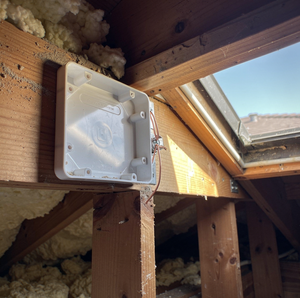
No. A ceiling box can carry a fan only if it is marked as acceptable for fan support, rated for at least the fan's weight, and fastened to the framing above the ceiling, either screwed to a joist or mounted on a brace that spans two joists. A box that has held a light fixture for years may meet none of those conditions, because a fixture asks a different job of it. Swapping a light for a fan starts with the box above the ceiling, and the choice of fan comes second.
How a Fan Loads a Box Differently from a Light
A light fixture is a still weight. Once it is screwed up, it pulls straight down on the box with the same force day and night, and a box built for fixtures is designed around that single, steady load.
A fan adds motion to the weight. When the motor starts, it pushes against the blades to get them turning, and the housing pushes back against its mount with a twist. Every speed change and every stop repeats that twist. Once the blades are up to speed, any small difference in their weight or pitch turns into a sideways push that cycles with each revolution. The box takes it all: the weight hanging down, the twist at start-up, and the vibration for as long as the fan runs.
A box held by two nails through a thin bracket, or clamped to the drywall with no framing behind it, can hold a light for as long as the fixture stays up, because nothing works at its fasteners. Hang a fan from it, and each start, stop, and revolution works those same fasteners, loosening screws and enlarging nail holes until the box begins to shift. A fan that sways or clicks has several possible causes, and a box working loose is one of them.
The Marking That Makes a Box Fan-Rated
A box is fan-rated because it has been tested and listed for that use, and the listing appears as words on the box itself. The wording reads "Acceptable for fan support" or close to it, stamped into the metal, molded into the plastic, or printed on a label inside. A box listed for a fan heavier than 35 pounds also carries a weight, in pounds and kilograms, giving the heaviest fan it is listed to hold; without a figure, the listing covers fans up to 35 pounds. Where that wording is missing, the box is a fixture box, whatever it looks like.
Appearance alone does not settle it. A round metal box can come in a fixture-only version and a fan-rated version that look alike from below, and a plastic box can carry a fan listing while a metal one lacks it. The rating also assumes the box is mounted with the fasteners and the brace or joist fixing it came with. A fan-rated box hanging from drywall clamps has lost the rating it was sold with.
Reading the marking means seeing inside the box, which with a light in place means lowering the fixture's canopy. That starts at the panel: the breaker for that circuit goes off, not just the wall switch, because a switch can leave a hot conductor in the box. With the circuit confirmed dead at the box, the canopy comes down far enough to reveal the box's interior walls, where the wiring and any weight sit. A heavy fixture held up by nothing but its wires is a job to leave for the electrician.
The attic side tells the other half, where there is safe footing on the joists. From above, a box screwed through its back or side into a joist, a bar spanning two joists with the box fastened to it, and a box with nothing behind it but drywall are all easy to tell apart.
A fan hung from a box without a fan-support marking can tear loose while running and bring the motor and blades down together. Keep that fan switched off, keep people out from under it, and have an electrician fit a fan-rated box.
Where Common Ceiling Boxes Stand
Each box that turns up behind a ceiling fixture pairs with its own answer on fan support and its own next step.
| Box type | Fan-rated? | What changes for a fan |
|---|---|---|
| Plastic light-fixture box nailed to a joist | No, unless it carries a fan-support marking | It comes out, and a fan-rated box fastened to framing goes in |
| Pancake box screwed flat to a joist | Only when marked for fan support | A marked one stays if the fan is within its weight and the wiring fits; an unmarked one is replaced |
| Metal box on a brace bar between joists | Depends on the bar and the box, and the marking decides | A fixture-only bar gives way to a fan-rated brace and box |
| Retrofit expanding brace with its box | Yes, when the brace and box are sold and marked for fans | It goes in through the existing ceiling hole |
The plastic fixture box fastens to the side of a joist with nails through a molded bracket, and it holds a light well. Repeated twisting can loosen those nails or crack the plastic around them, and that repeated twist is the load a fan brings. Some plastic boxes are built and listed for fans and say so, so the marking is still the test.
A pancake box is a shallow round box, about half an inch deep, that screws flat to the underside of a joist where the fixture lands directly below one. Because it is tied straight to the framing, a pancake box marked for fans can carry one. Its shallow body is the limit: it holds only a few conductors, and a fan with a light kit on its own switch can bring more wires into the box than a pancake box has room for.
A metal box on a brace bar is the new-construction mount for a fixture that lands between joists. The bar is nailed or screwed to the joists on each side, and the box hangs from it. Bars and boxes come in fixture-only and fan-rated versions, and both must carry the fan listing.
Retrofit Braces Between Joists
When the box sits between joists and the space above it is out of reach, such as a first-floor ceiling under a finished second floor or an attic too low to crawl, a retrofit brace does the work from below.
With the old box out, the brace is a telescoping steel bar with toothed or pointed ends, and it slides up through the ceiling hole to rest on top of the drywall, across the gap between two joists. Turning the bar lengthens it until its ends bite into the joists on both sides and lock there. The new fan-rated box then fastens to a saddle clamped onto the bar, so the fan's weight passes through the bar into the framing, and the drywall carries none of it.
Each brace covers a range of joist spacing printed on its package, and a bay outside that range needs a different brace or a mount built from above. The ceiling hole has to be large enough for the brace to pass through; an opening left by a small box is cut larger before the brace goes in.
Where the attic is reachable, the same result can be built from above. A fan-rated brace fastens between the joists, or a length of solid wood blocking is screwed in between them for the box to fasten to.
Heavy Fans and the Box's Weight Limit
A fan-rated box's limit is its marked weight, or 35 pounds where no weight is marked, and the fan's own weight is in its specifications. The box's limit has to meet or exceed the fan's. Fan-rated box listings reach 70 pounds at the top, and a box marked lower than that is limited to its own figure. Large-diameter fans, fans with metal or solid wood blades, and fans with built-in light fixtures can weigh enough to press against a box's limit, so the two numbers are compared before the fan goes up.
A fan heavier than the box's marking has two sound paths. One is a box listed for a higher weight, fastened with the hardware it came with. The other, for a fan heavier than any box listing, is support that runs from the fan's bracket straight to the framing, independent of the box, so the box houses only the wiring and carries no load.
The limit also assumes a sound mount. A box marked for the right weight but fastened to a split joist, or hanging from screws that have worked loose, cannot deliver the number printed inside it. A fan already hanging from a box of unknown rating that has started to sway, rattle, or drop is switched off and stays off until the box and its fastening have been checked.
What a Fan Installation Involves
Hanging a fan is electrical work with a structural step in the middle, and the order matters. The electrician shuts off the breaker feeding the fan location and confirms the wires are dead before touching the box. The box is identified by its markings and mounting, then kept, braced, or replaced to suit the fan's weight. The fan's mounting bracket goes onto the box, the motor hangs from the bracket, the wiring is connected inside the canopy, and the blades go on last so the fan can be balanced and tested at each speed.
Control is the other decision. With a single switched conductor at the ceiling, the fan and its light kit turn on and off together, and the pull chains on the fan set speed and light separately. Separate wall control of the motor and the light requires a switch leg with an extra conductor and a cable run between the switch box and the ceiling box that carries one feed to the motor and another to the light. Where the existing cable has only one switched conductor, a new cable is fished from the switch to the ceiling, and a single-gang wall box can be enlarged to hold two controls side by side.
A wall control for fan speed has to be one made for fan motors. An ordinary dimmer meant for lights, wired to a fan motor, can make the motor hum and run hot. Work of this scope is done under a permit where one is needed.
Frequently Asked Questions
A fan-rated box is threaded for 10-32 machine screws, heavier than the 8-32 screws that hold light fixtures, and it ships with them. Thinner fixture screws will not grip those threads, so the bracket would be held by screws that are not engaged.
Yes, with a downrod mount. The ball at the top of the downrod seats in a hanger bracket that lets the fan hang plumb while the box follows the ceiling's angle. Each fan's instructions state the steepest slope its bracket accepts; beyond that, an angled-ceiling adapter extends the range.
Yes. The figure to compare with the box's marking is the whole assembly as hung: motor, blades, blade arms, downrod and light kit together. A fan that sits just under the box's limit without its light kit can pass it once the kit is added.
The box still has to be marked for fan support, and outdoors it also has to suit a damp or wet location. Fans carry a location rating of their own: a damp-rated fan suits a covered porch, while a spot that rain or sprinkler spray can reach calls for a wet-rated one.
It can. A receiver fitted inside the fan's canopy or mounting bracket takes the single switched feed and splits it into separate motor and light control, so both answer to a handheld or wall-mounted remote. The wall switch then stays on because switching it off cuts power to the receiver as well.
The blades need to clear the floor by at least 7 feet. On a low ceiling, a flush or hugger mount keeps the motor tight to the ceiling to reach that clearance; on a tall one, a longer downrod brings the blades down to where they move air through the room.
Hire an electrician for the ceiling fan swap — the box above the fixture checked for its fan-support marking, a fan-rated box or brace fastened to framing where it falls short, and the fan hung, wired, and balanced. Efficient Electric serves Phoenix, Peoria, and the surrounding West Valley. Call 623-810-9905.