
Are Recessed Lights Safe Against Attic Insulation? Read the Label
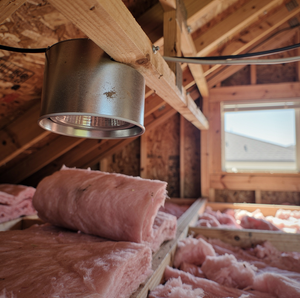
Whether insulation can sit against a recessed light is decided by the housing above the ceiling, not by the bulb or the trim you see from below. Some housings are tested for burial; others shed heat into the open air and become a hazard when blankets or loose fill close around them. The table below sorts the five kinds of recessed fixture you are likely to find.
| Fixture type | Can insulation touch it? | What to check |
|---|---|---|
| IC-rated housing | Yes, it is built for direct contact and full coverage | The "IC" marking on the label, and the lamp type and size it lists |
| Non-IC housing | No, insulation has to be held back from its sides and top | Whether insulation has been blown or laid against it since it went in |
| Airtight (IC-AT) housing | Yes, and it also limits air passing between the room and the attic | An "AT" or airtight marking, plus a gasket where the trim meets the ceiling |
| LED retrofit trim in an old can | Only if the can underneath is IC-rated | The housing's own label, since the retrofit does not change it |
| Integrated LED wafer light | Only as far as its own marking allows | The IC and airtight markings on the fixture or its attached junction box |
How a Can Light Sheds Heat, and What Insulation Does to It
A recessed housing is a metal cylinder open at the bottom, with a lamp socket near the top and a small junction box fastened to its frame. With a filament or halogen lamp, the great majority of the energy drawn leaves as heat rather than light, and it collects in the top of the can, beside the socket and the wire feeding it.
That heat moves through the metal wall into the surrounding air, which rises and carries it away, and both steps depend on open space around the housing. Pack fiberglass or cellulose against the wall and over the top, and that air stops moving. The can keeps generating heat at the same rate with nowhere to dissipate it. Hence, the temperature at the socket and in the junction box climbs until the housing and the insulation around it settle into a new, hotter balance.
The attic air the housing sits in sets the starting point for that balance. A fixture can only cool itself to the temperature of the surrounding air, so the hotter that air starts, the smaller the margin between normal operation and a temperature that chars wire jackets and paper facings. An attic that bakes through a long summer leaves less of that margin, so the IC rating of the can, the wire jacket's temperature rating, and each splice in its junction box all have less room for error. In an attic that stays mild, those same three things still determine whether the fixture runs safely, with more room before a weak one becomes a problem.
What an IC Rating Means
IC stands for insulation contact. An IC-rated housing has been tested with insulation packed against it and over it, running the largest lamp it is listed for. It stays below the temperature limits for its parts and the materials touching it. Some IC housings use a second can inside the outer shell, so the lamp heats the inner can and an air gap keeps the outer wall cooler; others hold the lamp wattage low enough that the heat stays manageable even when buried.
A non-IC housing is built on the opposite assumption. It expects open air around it and can accept a larger lamp because of that air. Its outer wall runs hotter, and its sides are sometimes perforated to let heat escape. Held clear of insulation, it is a sound fixture; buried, it loses the cooling it was designed around. For that reason, a non-IC can needs about three inches of open space around its sides, with nothing laid over its top that traps heat.
Thermal Protectors That Cycle the Light Off
Housings built for screw-in lamps can carry a small heat-sensing switch, called a thermal protector, mounted on the can or near the socket. When the housing passes a set temperature, the switch opens, and the lamp goes dark. Once it cools, the switch closes, and the light returns, so from below the light shuts off, stays dark for some minutes, then returns on its own.
That cycling means the protector is sensing more heat than it should, or has weakened with age. Several things can cause it: insulation packed against a non-IC can, a lamp larger than the housing is listed for, a trim that does not match the housing, or a protector that trips early. Each points to a different fix, and bypassing the switch fixes none of them.
That on-off pattern is a different event from the shimmer of an LED lamp mismatched to its dimmer.
Repeated trips also leave a record in the wiring. A can that has cycled for years has run near its limit on each cycle, and the short wire between the junction box and the socket sits closest to that heat.
Wire at a can that looks darkened or cracks when bent has been cooked by the fixture, and handling it can expose bare copper. Leave it alone, switch that circuit off at the breaker, and have an electrician replace it.
Air Leakage Through Cans and Why It Matters
An ordinary can is a hole in the ceiling. The gap around the trim, the slots and knockouts in the housing, and the space around the socket all let air move between the room and the attic. When the house is warmer than the attic, warm room air rises out through the cans. When the attic is the hotter space, the flow can reverse, and attic air laden with insulation dust can drift down into the room.
Either direction costs you: conditioned air leaves the house, attic heat and dust come in, and warm, humid room air reaching a cold roof deck can condense there.
Insulation acts as a filter for air passing through it, so fiberglass around a leaky can may darken in a ring where years of room air carried dust into it. A dark halo on the insulation around a housing, or a gray shadow on the ceiling paint around the trim, can be a sign of air moving through that fixture, though an old roof leak can also stain the insulation.
An airtight housing, marked IC-AT or ICAT, closes those paths with a sealed can and a gasket at the ceiling. It carries the IC rating as well, since sealing a housing only makes sense if insulation can then cover it. Stuffing foam or tape around a non-IC can to stop the draft boxes in the heat that the can relies on losing to the air, trading an energy problem for a fire one.
LED Retrofits: What Changes and What Stays the Same
An LED retrofit trim is a one-piece module that screws into the existing socket through an adapter and clips up into the old can with springs. An LED module that replaces a large filament lamp produces a fraction of the heat, so the housing's own thermal protector may never reach its trip point again.
What it does not change is the housing's rating. The screw socket is still there, so anyone can later remove the retrofit and put a filament lamp back in, and a non-IC can buried in insulation is then back to its original hazard. A retrofit is not a reason to let insulation close in around a non-IC housing.
Some retrofit trims have a foam or rubber gasket at the ceiling line, which closes the gap around the trim; the slots and openings higher up in the old housing are not sealed by it.
Integrated wafer lights take the housing out of the picture entirely. The light is a thin disc that sits in the ceiling hole and is wired to a small driver box. With no can, the fixture itself carries the rating, and it can be marked IC, airtight, or both, so its own label is the one to read.
How to Identify a Housing's Rating
The rating lives on a label inside the can. Turn the fixture off at the breaker first, not just at the wall switch, and let the lamp cool. Remove the bulb, pull down the trim (held by springs or clips), and look up at the inner wall of the housing. A paper or foil label there lists the fixture type and lamp limits, and it says in plain words whether the housing is IC or non-IC, and whether it is airtight.
The same label may also appear on the housing frame or the junction box, which you can see from the attic side without removing anything. From above, a can with a cleared ring of open space around it is a hint that someone treated it as non-IC. A can with insulation right against it tells you nothing on its own; it may be rated for that, or it may be the problem.
Older labels fade, peel, or get painted over. When the label is gone or unreadable, the safe assumption is that the housing is non-IC, and it is handled that way until an electrician identifies it.
Options for a Non-IC Can Already Buried in Insulation
Finding a non-IC housing with insulation packed around it leaves two sound paths. The first is to restore the clearance by pulling the insulation back from the sides and top of the can with the circuit off and the footing kept on the joists, so that open air surrounds it again. That suits an attic with room to reach each can and only a few of them, though it leaves a gap in the insulation and a leaky housing in place.
The second is to replace the housing with an IC-rated and, ideally, airtight one. That fixes the heat and the air leak together, lets the insulation close in fully, and gives the fixture a fresh supply connection. It is the lasting answer for a ceiling full of old cans, and the right one for any can whose wiring shows heat damage.
A retrofit trim alone is not a third path, and neither is a lower-wattage bulb: each lowers the heat for now but leaves an untested housing buried, waiting for the next larger bulb.
Frequently Asked Questions
Not always. An IC rating covers loose-fill and batt insulation; contact with closed-cell or open-cell spray foam, which cures with its own heat, is a separate rating, and housings that carry it say so on the label.
It is the minimum temperature rating for the supply wire that feeds the fixture's junction box. Wire with a lower-rated jacket, which some older homes have, can degrade at that connection over time, so an electrician matching new wire to the can uses a jacket rated at least that high.
An airtight rating means the housing has been pressure-tested and leaks no more than 2.0 cubic feet of air per minute at a pressure difference of 75 pascals. A trim gasket that goes missing or gets crushed during a later trim swap can reopen that leak path even though the can itself still tests sealed.
Yes. Some labels list separate maximums for each lamp shape, such as a standard bulb versus a reflector lamp, so the applicable limit is the one printed for the shape in the socket.
Where the joist layout allows, yes. Remodel housings are built to install from below through the existing ceiling hole, with clips that grip the drywall, while new-construction housings nail or bar-hang to the joists before the ceiling goes up. The hole size and joist position decide which fits.
It sits on top of the ceiling drywall next to the opening, and it is reachable back through that hole by lowering the fixture. That keeps the connection serviceable without attic access, as long as the box stays within arm's reach of the opening.
Swap old cans for IC-rated, airtight housings — each label read, the wiring at every can checked, and the cans that cannot share an insulated ceiling replaced. Efficient Electric serves Phoenix, Peoria, and the surrounding West Valley. Call 623-810-9905.