
Does an EV Charger Need a Panel Upgrade? What Decides It
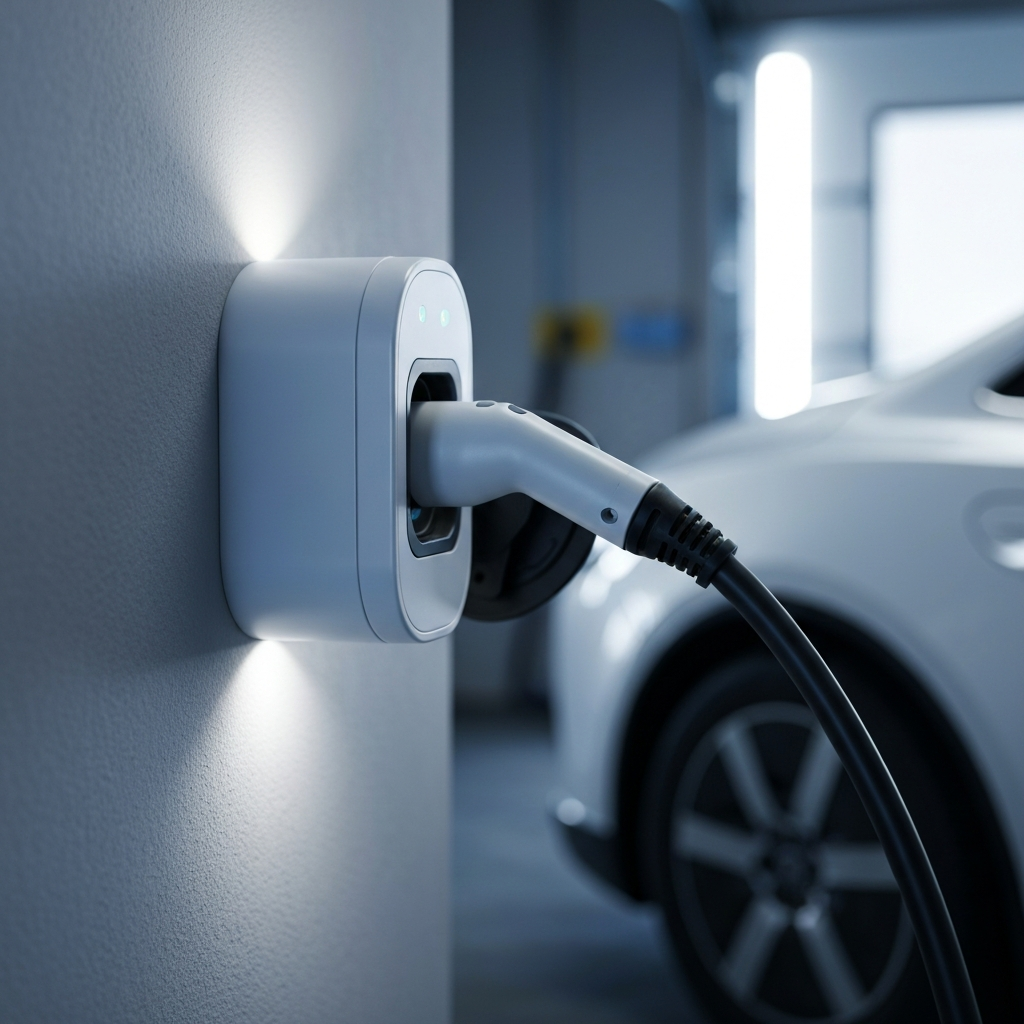
Ask five people whether a new EV charger requires a panel upgrade, and you will get five answers: half insisting it is mandatory, the other half swearing it is never needed. Both camps are wrong to talk in absolutes, because the charger by itself does not decide anything. What decides it is spare capacity: how much of your electrical service is already spoken for by everything else in the house, and how much room is left once the charger's continuous draw stacks on top. That is a math question, not a matter of how old the panel is or which brand is on the door. A 20-year-old 200-amp service can accommodate a charger without a second thought, while a crowded, newer panel might not.
Start with what a Level 2 charger actually pulls, because that number is what everything else hangs on. A standard wall outlet provides Level 1 charging at 120 volts and roughly 12 amps, which delivers about 3 to 5 miles of range per hour. A Level 2 charger runs on a 240-volt circuit, the same kind of supply your electric dryer or range uses, and it draws far more current: commonly 32 amps for a plug-in unit, up to 48 amps for a hardwired one. That is a continuous, hours-long draw, not the quick spike of a microwave. And it lands on the same electrical service that already feeds your air conditioner, water heater, oven, and everything else.
Why the Charger Competes With the Rest of the House
Think of your electrical service as a single pipe coming in from the street. The main breaker at the top of your panel is stamped with its size, usually 100, 125, 150, or 200 amps, and that number is the total current the whole house can pull at one moment before the main trips. Every large appliance shares that one pipe.
An EV charger is one of the thirstiest things you can add to it. A 48-amp hardwired charger is asking for nearly a quarter of a 200-amp service, or almost half of a 100-amp one, and it wants that current for hours at a stretch. The question an electrician has to answer is not "Does the charger fit on a breaker?" but "Does the house have that much headroom left after everything else is accounted for?"
That headroom shifts with the calendar, which is worth keeping in mind. During the hottest stretch of the year, the air conditioning runs long and hard, so your baseline draw is higher, and the spare capacity is thinner. In mild months, the same panel has more room to give. A good sizing decision has to assume the worst case, the day the AC, the oven, and the charger could all be running, not the easy day.
So Does That Mean You Need a Panel Upgrade?
Usually, no. Most modern homes with a 200-amp service and ordinary appliance loads can take a Level 2 charger on a new double-pole breaker without touching the service at all. A meaningful share of homes, especially older ones, do need electrical work beyond a simple charger circuit. The trick is knowing which homes those are, and that is decided by a load calculation, not a guess.
A load calculation is the piece homeowners tend to skip, and electricians never do. It adds up the demand for everything on the service, using standard factors for how much of each load realistically runs at once, and then compares that total to the size of your main breaker. If the existing demand plus the charger stays under the service rating, you are clear. If it pushes over, something has to give. Two panels of the same age can land on opposite sides of that line depending on whether the home has gas or electric heat, one or two AC units, a pool pump, a spa, and so on.
There is also a second, separate way a panel can be "full," and people mix the two up constantly. One is running out of amperage, the capacity problem above. The other is simply running out of physical breaker slots, with plenty of amperage to spare. A panel can have room on its bus but no empty space to land a new two-pole breaker. That is a much smaller problem than a true capacity shortfall, and it rarely calls for a service upgrade.
| Your situation | What it usually means |
|---|---|
| 200A panel, modest appliance loads, open slots | Charger adds on its own breaker; no upgrade. |
| 100–150A panel with electric range, dryer, and AC | Load calculation decides; load management often solves it. |
| Plenty of amperage but no empty breaker spaces | A subpanel or breaker consolidation, not a new service. |
| 100A service is already close to its limit | Service upgrade, or a managed lower-amp charger. |
| Old panel, aluminum feeders, no spare capacity | Charger usually folds into a full panel or service upgrade. |
What a 40 or 50-Amp Charger Circuit Needs
Say the load calc clears, and you have capacity. The circuit itself still has to be built for continuous duty, and that changes the math from what you might expect. Because a charger runs for three hours or more without stopping, it counts as a continuous load, which may use only 80 percent of the circuit's rating. So a 40-amp breaker is rated to carry a 32-amp charger, and a 50-amp breaker carries 40. To feed a charger set to its full 48 amps, you need a 60-amp circuit. The wire follows suit: a 50-amp circuit is typically 6-gauge copper, a 40-amp one 8-gauge, sized to carry the current without heating up over a long session.
How the charger connects matters too. A plug-in unit lands on a NEMA 14-50 receptacle, the same 240-volt outlet pattern as a range, and most plug-in chargers cap themselves near 32 amps on that setup. Hardwiring the charger directly to the circuit is what lets it reach the full 40 or 48 amps for faster charging. The receptacle route is convenient and lets you unplug and move the unit, but a cheap or loosely wired 14-50 outlet is a known heat point, so the quality of that connection is not a place to cut corners.
When the Panel Really Is Full: Your Options
If the load calc says there is no room, you are not automatically staring down a torn-out panel. There is a ladder of solutions, and a service upgrade sits at the top, not the bottom.
Load management (EVEMS): This is the option that saves the most homes from a service upgrade. An electric-vehicle energy management system monitors the total current the house is drawing and throttles or briefly pauses the charger whenever the rest of the home spikes, then returns the power when demand drops. In practice, the charger quietly gives way when the oven and AC kick on, then resumes. Because it guarantees the charger will step aside, a load calculation can be run as if the charger will never contribute to the peak, which frequently lets a 100- or 125-amp service take an EV it otherwise could not. Some chargers have this logic built in; others use a separate current-sensing device wired at the panel.
A subpanel: When the real problem is empty breaker slots rather than amperage, an electrician can run a feeder from the main panel to a smaller subpanel and land the charger there. This buys physical space for the charger circuit and any future additions without enlarging the service. It is the common fix for a panel that has plenty of capacity but no open positions left.
A service upgrade: When the service itself, often an older 100-amp one, simply cannot carry the added load, the fix is to increase the service, typically to 200 amps. This is the biggest of the three because it reaches past your panel to the utility's equipment: a new meter, a new main panel, usually a heavier feeder, and coordination with the power company for the actual capacity increase. It is also the option that solves everything at once, which is why homes with an aging panel, dated aluminum feeder connections, and no spare room often bundle the charger into a single upgrade rather than paying to work around a panel that was due for replacement anyway.
Which rung you land on is what the load calculation and a look inside your panel are there to determine. A charger on a healthy 200-amp panel is a simple add. A charger on a maxed-out 100-amp service is a real project. Most homes fall somewhere in between, and load management has widened the middle considerably.
Frequently Asked Questions
You can, and for some drivers, it is enough. Level 1 charging on a standard 120-volt outlet needs no new circuit and no panel work at all, but it only returns about three to five miles of range per hour, so an overnight charge adds maybe 40 to 50 miles. If you drive a plug-in hybrid or rarely put on many daily miles, that can cover you. For a full battery-electric car with a longer commute, Level 1 usually cannot refill the battery overnight, which is what pushes most owners to Level 2.
Only when the rest of the house is drawing hard at the same time, and only for as long as that lasts. Most EV charging happens overnight when the oven, dryer, and much of the house are idle, so in real use, the charger often runs at full speed the entire session and never gets throttled. The device is insurance for the rare moment when several big loads overlap, not a constant brake. If you routinely charge during dinner while the AC and range are running, you might see it ease the charger back, but the car still charges, just a little slower during that window.
Open the panel door and read the number stamped on the main breaker at the top; it will say 100, 150, 200, or similar, and that is your service size. One caution: the main breaker rating and the panel's actual bus rating are not always the same, and an older panel can hide a smaller true capacity than the breaker suggests. Counting your open breaker spaces tells you about slot room, but nothing about amperage headroom, which is why the load calculation still has to be run even when the number looks reassuring.
Yes, and it is a popular choice because you can unplug the charger and take it with you. The tradeoffs are worth knowing. A receptacle-fed charger generally tops out near 32 amps, while hardwiring can reach 48 for faster charging. Modern installations include GFCI protection on a 240-volt charging receptacle, and the outlet itself must be a quality unit rated for continuous EV duty, because bargain-bin 14-50 receptacles sold for occasional RV use have a reputation for overheating under an hours-long charging load.
They can, without doubling your electrical demand, which surprises people. Some chargers offer automatic load sharing: two charging units connect to one circuit and automatically split the available current, giving all of it to whichever car is plugged in and dividing it when both are. There are also single chargers with two connectors that alternate or share output. This lets a two-EV household avoid running a second heavy circuit or upsizing the service, though each car naturally charges more slowly when they overlap.
It can, and not always in the direction you would guess. Solar and battery systems feed power back into the same panel, and there are limits on how much a given panel bus can safely accept from the combination of the utility and a backfeed source. A home already carrying solar may have less room on the busbar for a large new charger breaker, or may need the charger positioned carefully relative to the solar connection. On the other hand, a battery can supply the charger during peak hours and take pressure off the service. It is one more reason the whole picture, not just the charger, drives the answer.
What It Comes Down To
Whether an EV charger forces a panel upgrade is a capacity question, and capacity is measured, not assumed. The charger's appetite is fixed and easy to name. What varies is how much of your service is already spoken for, whether you are short on amperage or only short on breaker spaces, and whether a load management system can let the charger share what you have. A home with a roomy 200-amp panel is often a simple afternoon. A home on a tired 100-amp service may be better served by folding the charger into an upgrade that was coming regardless. The only way to know which one you are is to have the load actually calculated, and the panel actually opened before the charger comes out of the box.
Get a load calculation and a real look inside your panel before you commit to an EV charger install — it is the difference between a clean add-on and an unexpected upgrade. Efficient Electric serves Phoenix, Peoria, and the surrounding West Valley. Call (623) 810-9905.