
Do You Need a Whole-House Surge Protector? How to Decide
The surge protector most people trust is the power strip behind the television, the one with six outlets and a little reset button that glows green. It feels like a safeguard because the packaging promised joules and protection. What it actually guards is narrow: only the devices plugged into that strip, and only against surges that arrive through those particular outlets. The equipment that costs the most to replace in a house is not plugged into a strip at all. Your air conditioner, furnace, water heater controls, well pump, oven, and the hub running your smart lights are wired straight into the panel, out of reach of anything you can buy at a checkout counter. That gap is the whole reason panel-level surge protection exists, and it is the first thing to understand before deciding whether you need it.
A whole-house surge protector is not a bigger power strip. It is a different device doing a different job at a different place in the electrical system. Once you see what a surge is and where it comes from, the question of whether one belongs on your panel mostly answers itself.
What a Surge Actually Is
A surge is a brief spike in voltage, lasting millionths of a second, that pushes the system above its normal level. Household circuits typically run at a nominal 120 volts to each hot leg. A surge can drive that to several hundred or even several thousand volts for an instant. Two very different sources create them, and most homeowners only think about one.
The dramatic source is external, arriving from outside the house. A lightning strike near a power line, a downed line, a utility crew switching the grid, or a large transformer cycling can all send a spike down the service conductors and into your panel. Storm season raises the odds of the lightning variety, but grid switching and utility events push smaller surges through the wires in every season, on clear days as much as stormy ones. You do not need a direct hit to feel it, since a strike a quarter mile away can couple enough energy onto the line to matter.
The quieter source is internal, generated inside your own walls. Every time a large motor shuts off, the magnetic field that was running it collapses, and that collapse kicks a brief voltage spike back onto the circuit. Your air-conditioning compressor, the well pump, the refrigerator, a pool pump, and even a laser printer warming up all do this many times a day. Each internal surge is small next to a lightning event, but they happen constantly, and power-quality studies commonly attribute most surge activity in a typical home to these internal, self-inflicted spikes rather than to the weather. They are the slow erosion that ages circuit boards long before a storm ever finishes one off.
How a Panel-Mounted SPD Clamps the Voltage
A surge protective device, or SPD, does one thing: it watches the voltage and, the instant it climbs past a safe threshold, it opens a path that shunts the excess energy away from your circuits and into the ground and neutral. The workhorse component in most units is the metal-oxide varistor, a ceramic block that behaves as an insulator at normal voltage and becomes conductive within nanoseconds once the voltage exceeds its rated value. When the surge passes, the varistor goes back to blocking.
Two numbers describe how well it does this. The first is the let-through voltage, listed on the unit as its voltage protection rating (VPR). It tells you how much voltage still reaches your devices during a clamp, so lower is better. Residential units commonly carry listed ratings ranging from a few hundred to about a thousand volts per mode. The second is the surge current rating, given in kiloamps (kA), which describes how large a single surge the device can divert. A residential panel SPD is often rated somewhere around 40 to 70 kA. Neither figure is a marketing slogan, since both are tested to the UL 1449 standard, which lets you compare two devices on the same footing.
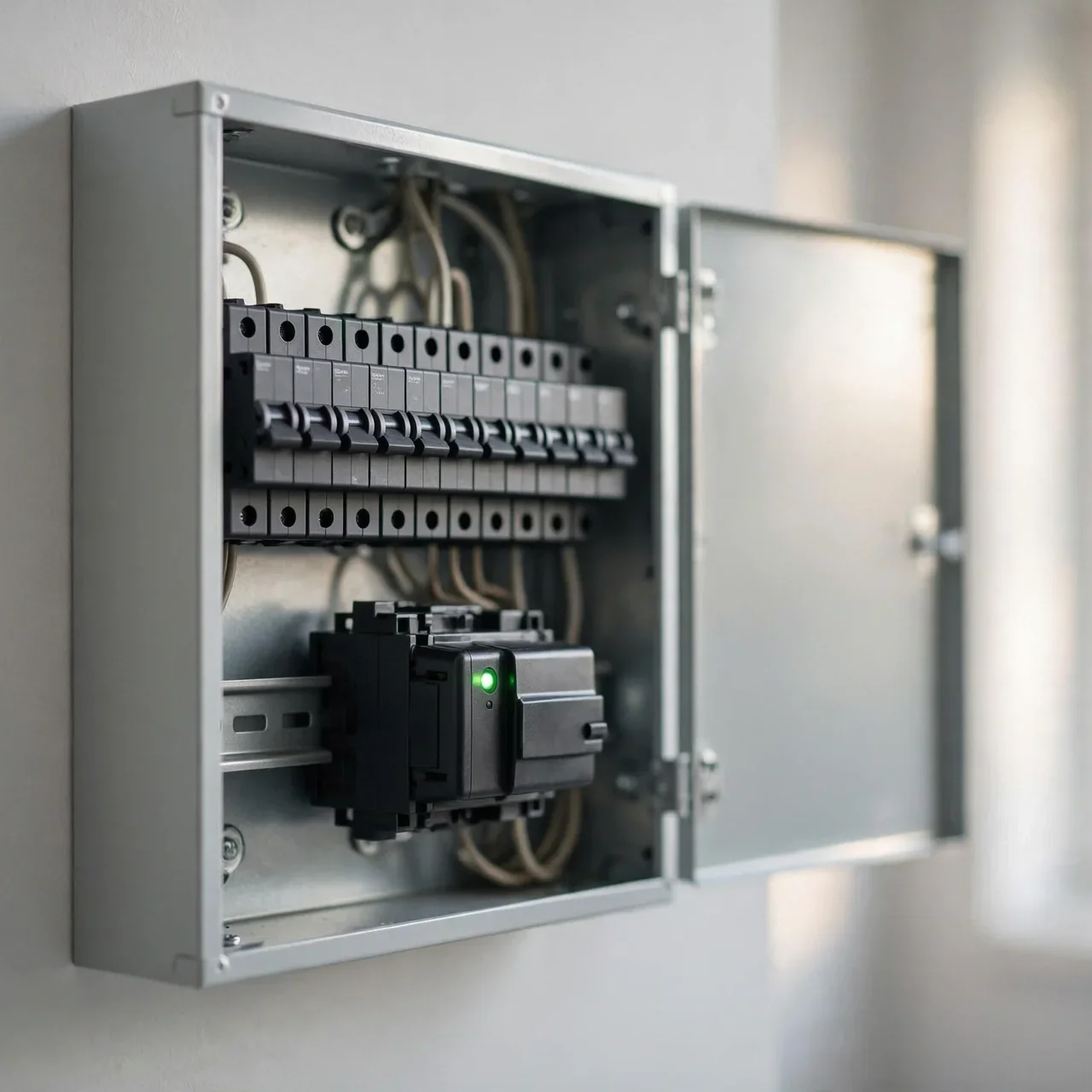
Where the device sits determines its type. A Type 1 SPD is installed on the line side, ahead of the main breaker, sometimes right at the meter, and is designed to withstand the higher energy of a nearby lightning event at the service entrance. A Type 2 SPD, the common residential whole-house unit, mounts on the load side inside or beside the main panel, wired to a two-pole breaker. A Type 3 device is the point-of-use protector, the strip or receptacle that sits at least a cable run away from the panel, near the equipment it guards.
One detail decides whether any of this works: the ground path. An SPD has nowhere to send the surge energy unless it connects to a solid, low-impedance grounding system through short leads. Long, looping connecting wires add impedance and raise the let-through voltage, so an electrician mounts the device tightly against the panel with the shortest practical conductors and confirms the home's grounding and bonding first. A surge protector wired to a poor ground is mostly decoration.
It is also worth knowing that the device wears out. Every surge the varistor absorbs chips away at it, and after enough hits, or one very large one, it stops protecting. Better units carry a status indicator light or an audible alarm that signals the protection has degraded, so you are not left guessing whether it is still doing its job.
Why One Layer Is Not Enough
A panel SPD is powerful, but it is not the finish line. It knocks a multi-thousand-volt event down to a few hundred volts before it can spread through the house, which is exactly what saves your hardwired appliances. Those few hundred volts of let-through, though, can still be more than a sensitive circuit board wants to see, and the internal spikes created downstream of the panel never pass through the panel device at all. That is where point-of-use protection earns its place.
A good plug-in strip or protected receptacle at the computer, home theater, or network gear catches the residual let-through and small local spikes. These are the units rated in joules, a measure of how much surge energy they can absorb over their life before the internal varistor is used up. A higher joule rating generally means a longer service life, not a stronger single clamp. Point-of-use units also protect something the panel device cannot touch: the coax, ethernet, and phone lines that carry surges in through the cable or satellite connection, a common back-door path into a television or modem.
Layered protection is the real answer for most homes. The panel SPD handles large, whole-house events at the source, and the point-of-use devices clean up what remains while guarding the signal lines at the most sensitive equipment. Relying on either layer alone leaves a gap.
| Feature | Whole-house SPD (panel) | Power-strip SPD (point-of-use) |
|---|---|---|
| Where it sits | Wired to the main panel on a two-pole breaker | Plugged into a receptacle near the device |
| What it protects | Every circuit in the house at once | Only what is plugged into it |
| Surge size handled | Large external events (lightning-induced, grid switching) | Small residual and local internal spikes |
| Hardwired gear (HVAC, well pump, oven) | Yes | No |
| Coax, Ethernet, phone lines | No | Yes, on models with signal-line jacks |
| When it needs replacing | After the varistor degrades, a status light warns you | When the joule rating is used up, often silently |
Who Gets the Most Out of It
Whole-house surge protection is not equally valuable to every home, and framing the decision around what you actually own makes it clear.
The homes that benefit most are full of electronics and control boards. If you have several televisions, computers, a home theater, gaming consoles, and a router that never turns off, you own a lot of the exact circuitry that internal and external surges age and kill. Modern appliances make this stronger, not weaker: today's refrigerators, ovens, washers, and dishwashers run on microprocessor control boards that are far more surge-sensitive than the mechanical timers they replaced, and those boards are not a quick or simple replacement.
A few specific systems tip the decision hard toward yes:
• Variable-speed HVAC and heat pumps: The inverter and control board on a modern system are sensitive and not a simple swap, and the compressor is itself a large internal-surge source every time it cycles.
• A well pump or septic control panel: These run on motor controls and pressure-sensing boards, sit on their own circuits, and are disruptive to lose. Losing one can leave you without water until a replacement board is sourced.
• Smart-home equipment: Hubs, smart panels, thermostats, security cameras, and hardwired doorbells are always powered and always connected, so they take the constant low-grade internal spikes around the clock.
• Solar inverters and EV charging equipment: These tie into the main panel and represent significant electronics on their own dedicated circuits, which is why panel-level protection comes up whenever a home adds them.
The home that gains the least is the sparse one: few electronics, older mechanical appliances, not much connected. Even there, the math is shifting, because it is getting hard to buy any major appliance without a control board inside it. If your home is full of the equipment above, the decision leans strongly toward installing panel-level protection and adding point-of-use units at your most sensitive gear.
Making the Call for Your Home
Deciding on whole-house surge protection comes down to matching the protection to what your home actually runs. A house full of control boards, connected devices, and hardwired systems on their own circuits is the case the device was built for. Before installation, an electrician confirms the panel has room for a two-pole breaker and that the grounding and bonding are sound, since the SPD depends entirely on that ground path to do its work. From there, the practical setup is layered: the panel device at the source, and point-of-use protectors at the handful of spots that matter most, including the signal lines feeding your television and network. Get both layers in place, and the constant internal spikes and the occasional storm-driven surge both have somewhere to go besides your circuit boards.
Frequently Asked Questions
Not entirely, and no device on your panel is meant to. A direct strike to the house carries far more energy than any SPD is rated to absorb, and stopping that takes a lightning protection system with air terminals (rods), down conductors, and its own grounding, which is a separate installation. What a Type 1 or Type 2 SPD does handle well is the far more common case: the induced surge from a strike nearby, and the energy that couples onto the utility lines and travels into your panel. Those events happen many times more often than direct hits, which is why the panel device is the practical protection for most homes.
Yes. A whole-house SPD is the first stage, clamping the big event at the panel, but a point-of-use unit is the second stage that trims the residual let-through right at a sensitive device, and it can carry a lower clamping voltage than the panel unit because it handles far less energy. One caution worth noting: many products sold as power strips are just a row of outlets with a resettable circuit breaker and no surge protection at all, so check for a joule rating and a UL 1449 listing before you trust one to protect anything. The panel device and a true point-of-use protector cover different stages, not the same job twice.
It is not a plug-in job. A Type 2 unit is wired to a two-pole breaker inside the main panel, which means working next to the energized bus with the cover off, and a Type 1 lands on the line side ahead of the main breaker. Beyond the shock risk, the device only performs if the leads are kept short and the home's grounding electrode system and bonding are verified and correct, which an electrician checks as part of the install. Many areas also expect the work to be permitted. This is a standard electrician's scope, not a weekend project.
It protects against surges around the outage, but it does not keep anything running. Some of the worst surges occur when the grid re-energizes after an outage, when voltage snaps back and can overshoot; that reconnection spike is exactly the kind of event a panel SPD clamps. What it does not do is provide any runtime, because it is not a battery or an uninterruptible power supply (UPS). If you need equipment to ride through the outage itself, that calls for a UPS or a generator, which solves a different problem than surge protection.
Beyond the kA and let-through voltage on the label, look at how many modes the device protects. A basic unit may only clamp line-to-neutral, while a better one clamps all modes, including line-to-ground and neutral-to-ground, closing paths a cheaper unit leaves open. More energy headroom (higher joules and kA figures) also generally buys a longer service life, since each surge wears the varistor down. A status indicator, a replaceable cartridge, and a manufacturer's connected-equipment warranty are the other marks of a serious device rather than a token one.
Panel-level protection usually is not an option for a renter, since it means opening a panel you do not own and typically getting the landlord and an electrician involved. The practical route is point-of-use protection: quality plug-in strips or protected receptacles at your electronics, ideally ones with coax and ethernet pass-through for your television and network. If the landlord is open to it, a panel SPD is a small addition during any other electrical work, so it is worth raising when a unit is being updated.
Ask an electrician to check your panel's grounding and fit a whole-house surge protector — one visit protects every circuit in the house. Efficient Electric serves Phoenix, Peoria, and the surrounding West Valley. Call (623) 810-9905.