
How Many Circuits Can an Electrical Panel Hold? Check the Label
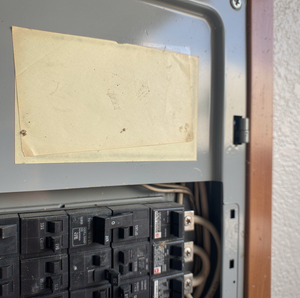
Swing open the metal door on your panel and look past the rows of breaker handles to the inside face of the door itself. There is usually a paper or foil label glued there, a little yellowed, printed in small type: a catalog number, a voltage, an ampere rating, a wiring diagram with numbered positions, and a line that reads something like "30 spaces, 40 circuits maximum." That label is the part that answers your question.
How many circuits a panel can hold is really four questions stacked together. How many physical positions does the bus have? How many of those positions has the manufacturer approved for tandem breakers? How much current can the bus and the main breaker carry? And how much of that current does the house already use? The first three are printed on that label. The fourth takes a load calculation.
The Label Inside the Door Sets the Ceiling
Every load center leaves the factory with a label that describes what it was tested to hold. It lists the manufacturer and catalog number, the system voltage (120/240 volts, single-phase, three-wire, typical of a house), the bus amperage rating, the number of breaker spaces, and the maximum number of circuits. It also lists the breaker types the manufacturer approves for that enclosure and shows a diagram marking which positions can take tandem breakers.
None of that changes when a new circuit gets added. A panel built for 40 circuits does not become a 44-circuit panel just because someone found a clip-on breaker, and a panel listed for one family of breakers does not become compatible with another just because the shapes look close. The label is the manufacturer's statement of what the enclosure, the bus, and the breakers were tested to do together, and the circuit limit on it is a hard number rather than a suggestion. Figure 42 comes from older residential panels built around a 42-circuit ceiling; plenty are still in service, but larger load centers made today are rated for more, and the figure on your own label is the one that applies.
You can read all of it with the door open and the breakers untouched. That is as far as the reading goes.
The label is on the door for a reason. Behind the inner cover, the service lugs above the main breaker remain energized even when the main is switched off. Leave that cover in place and let a licensed electrician handle anything behind it.
Breaker Spaces Are the Physical Count
A space is one position on the bus where a standard full-width breaker seats. Inside the panel, two vertical bus bars carry the two 120-volt legs of your service, and the stabs that breakers clip onto alternate between those legs as they run down the panel, so any two positions stacked one above the other on the same side sit on opposite legs.
That alternation determines how much room a circuit takes up. A 120-volt breaker grabs one stab on one leg and uses one space. A 240-volt breaker, the double-pole kind that feeds a range, a dryer, an air conditioner, a water heater, or an EV charger, needs both legs at once, so it spans two stacked spaces. A panel with 30 spaces does not have room for 30 new circuits if several of them are 240-volt loads; each of those consumes two.
This is also why a count of empty spaces on the door diagram tells you something real but incomplete. An open space is a place a breaker can physically go. It says nothing about whether the manufacturer lets a tandem go there, or whether the bus and the service have current to spare for whatever that breaker would feed.
Tandem Breakers Go Only Where the Label Says
When a label lists more circuits than spaces, the gap is the tandem allowance. A panel marked 30 spaces and 40 circuits can take tandem breakers, sometimes sold as twin or duplex breakers, in up to ten positions, because each tandem puts two 120-volt circuits on a single stab. A panel marked with equal numbers of spaces and circuits, such as 40 and 40, allows no tandems at all.
The diagram on the label shows which numbered positions are approved. The limit exists because the manufacturer tested the bus with tandems in those positions and no others.
Two limits come with tandems regardless of the label. A tandem serves only 120-volt circuits, so it can never support a 240-volt appliance itself; at most, consolidating two single-pole circuits onto an approved tandem frees up a full position that a double-pole breaker can then use. And once the approved positions are full, the circuit maximum on the label is reached, even if there is still open space elsewhere on the bus. A breaker that physically clips onto a position the label does not mark is a panel operating outside its listing, which is a different thing from a panel with room left.
The Busbar and Main Rating Cap the Current
The spaces and the circuit maximum describe how many breakers the panel holds. The bus rating and the main breaker describe how much current they can draw together. Those are separate limits, and a panel can run out of either one first.
The label gives the bus ampere rating, the most current the bars themselves are built to carry. The main breaker, at the head of the bus, is a separate part, and its handle shows the rating of the service it protects, often 100, 150, or 200 amps. Everything downstream draws through the main.
Add up the numbers on the branch breaker handles, and the total will almost always exceed the main breaker's rating. Twenty 20-amp breakers alone come to 400 amps on paper. That is normal, because each branch breaker is sized to protect its own wire, not to reserve a share of the service, and the lights, outlets, and appliances on those circuits never all draw their limits at once. It also means the sum of the handles tells you nothing about whether the panel is full. A panel can have ten open spaces and a service already running near its limit, or no open spaces and plenty of current left.
Where a house was built with a 100-amp or smaller service, that service was sized before today's air-conditioning, EV charging, rooftop solar, and household device loads were part of anyone's plan. On that panel, open spaces on the label can mislead: the diagram says a new breaker will fit, and nothing on the diagram says the main can carry what that breaker would feed. In a house built with a larger service, the same two readings apply. The main is simply a bigger number to divide, and a free space still has to be checked against it.
A clear phone photo of the door label, the main breaker handle, and the circuit list gives an electrician the model, bus rating, circuit maximum, and existing circuits before the visit, so the load calculation can start from real numbers.
A Load Calculation Decides Whether a Free Space Is Usable
Circuits are not the currency a service spends. Amps are. A new lighting circuit and a new range circuit might use one and two spaces, respectively, but the lighting circuit is on a 15- or 20-amp breaker, while a range circuit is commonly on a 40- or 50-amp breaker. Counting positions answers whether a breaker fits; it cannot answer whether the house can afford the load behind it.
A load calculation turns the house into one number, the load the service already carries, then adds the new circuit's load and checks the total against the main.
This is where the four questions meet. A panel can pass the space count and fail the calculation, because the positions are open but the service is spoken for. It can pass the calculation but fail the space count because the service has room, but every listed position is filled. Or it can pass both, in which case the answer to how many circuits the panel can hold is simply the circuit maximum on the label minus the circuits already installed.
When the Answer Becomes a Subpanel or an Upgrade
Which of the label's figures runs out first decides the next step. When the circuit maximum is used up, and the load calculation still leaves current, the shortage is positions, and a second enclosure fed from this one adds positions while the service stays as it is.
When the calculation lands near the main's rating, open positions no longer matter, since a breaker added anywhere still draws through that main. The question moves to the size of the service, which takes in the meter, the service conductors, and the panel. In a house with aluminum branch wiring, that scope also covers the circuits already in place, because each aluminum conductor has to land on a terminal rated for aluminum wherever it ends. In a house wired in copper, that part of the scope does not come up.
What does not work is stretching the label. A tandem pressed into a position the diagram does not mark, or a breaker model the label does not list, adds a circuit on paper and takes away the listing the panel's count depended on.
Frequently Asked Questions
That figure is about fault current, not everyday load. It states the largest fault current the panel-and-breaker combination is rated to withstand and clear, and many standard residential breakers carry a 10,000-amp interrupting rating, marked as 10 kA or 10kAIC. Breakers and panels with higher ratings, such as 22 kA, are available for services where the utility can supply more fault current.
Only a breaker made for that panel. The label lists the breaker types the manufacturer tested in that enclosure. A few makers also sell breakers that UL has classified for use in specific other brands' panels, and those are marked UL Classified with the panels they fit. A breaker that clips onto the bus without either marking is not a tested pairing, however well it seems to seat.
They close openings that no breaker is using. The inner cover has knockouts, one per position, and when a knockout is removed with no breaker behind it, a filler plate snaps in to cover the hole. A missing filler plate leaves an opening facing the energized bus, so an open slot in the cover is worth reporting to an electrician rather than taping it over.
Many panel-mounted surge protectors do. Plug-on types are built to match a specific panel line seat on the bus, like a double-pole breaker, and use two spaces, while other designs mount beside the panel and connect through a two-pole breaker, which also uses two spaces. On a panel with only one or two positions left, that is worth factoring in before planning another circuit.
A panel-mounted generator interlock works only with the backfeed breaker in the specific positions its kit is made for, usually the ones right beside the main breaker, so the sliding plate can block one while the other is on. If those positions already contain circuits, adding an interlock means either rearranging the panel or choosing a different transfer method, which is a design decision for an electrician.
Look for the catalog number on the outside of the door or on the enclosure. Leave the inner cover in place; if the markings you need sit behind it, have a licensed electrician read them. On many load centers, the catalog number itself carries the two figures: a sequence such as 3040 reads as 30 spaces and 40 circuits. From that number, an electrician can pull the manufacturer's full label information, including the tandem positions.
Before adding a circuit, schedule a panel and load check — an electrician reads the space and circuit limits on your label and runs the load calculation against your main. Efficient Electric serves Phoenix, Peoria, and the surrounding West Valley. Call 623-810-9905.