
Three-Phase Power: What It Is and Whether Your Building Has It
The equipment quote for your build-out came back with a line nobody explained: 208 volts, three-phase. Your landlord says the building has it. Your supplier says your suite does not. Between those two answers lies an electric service you have paid for every month without ever knowing which one your space runs on.
Three-phase is not an upgrade you buy for its own sake. It is the shape of the power arriving at your building, and it is why some equipment runs in your space and some will not. The rest explains what three-phase is, what the two common commercial services feed, and how you can identify yours from your bill, your meter, and your equipment nameplates, without opening anything.
What Three-Phase Power Actually Is Inside the Wire
Single-phase power arrives as one alternating supply. It rises to a peak, falls back through zero, reverses, and repeats sixty times a second, so the power reaching a load pulses rather than holding steady. A house lives with that comfortably. Lights and electronics do not mind the gaps, and a small motor coasts through them on its own inertia.
Three-phase splits the supply into three, each one offset from the next by a third of a cycle, so one of them is always near its peak. Delivery becomes continuous. It also changes the arithmetic: line-to-line voltages in a three-phase system are typically 1.732 times the phase-to-neutral voltage. Multiply 120 by that figure, and you get 208, not the 240 a home would give you.
The Two Commercial Services You Are Most Likely to Meet
Most commercial buildings sit on the first of them. The most common commercial building electric service in North America is 120/208 volt wye, used to power 120-volt plug loads, lighting, and smaller HVAC systems. Four conductors come in: three hot legs and a neutral. Any leg measured to neutral is 120 volts, and any two legs measured to each other are 208.
Above a certain building size, the numbers change. In larger facilities, the voltage is 277/480 volts, used to power single-phase 277-volt lighting and larger HVAC loads. A 480-volt service still provides 120-volt receptacles, but they come through a step-down transformer inside the building, not directly from the service.
Telling Which Service Your Building Already Has
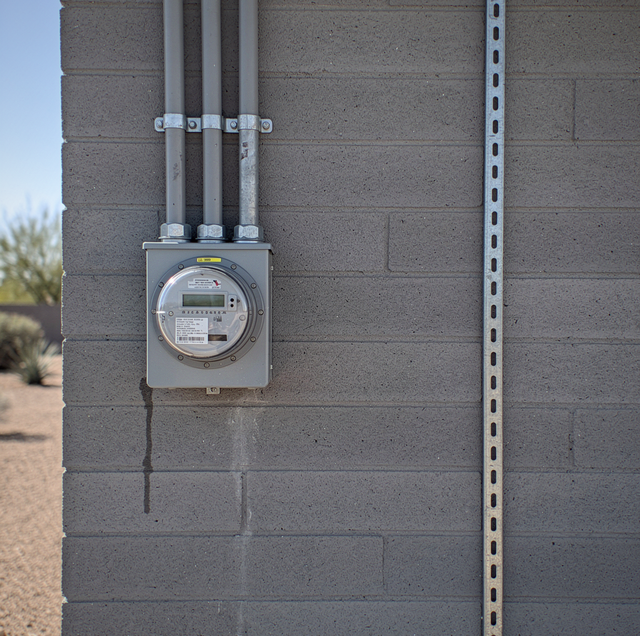
Three places carry the answer, and none of them involve opening an enclosure. The first is the utility bill you already receive, because a commercial account names the rate schedule it is billed on, and a schedule written for a three-phase general service is not the same schedule as a small single-phase one, usually with a demand charge alongside the kilowatt-hours. The second is the meter and what feeds it, since a three-phase meter is a different form than a residential one and the conductor count entering the building from the utility's transformer is visible from the ground. The third is the equipment already in the space: the data plate on a rooftop air-conditioning unit, an elevator machine, a walk-in refrigeration rack, or a shop compressor states the phase and the voltage it was built for.
The paper version of the same answer lives with the building. Record drawings and the one-line diagram in the property manager's file show the service that was installed, and a lease often describes the suite's electrical capacity in a sentence or two. Treat all of that as a starting point. Buildings change tenants faster than they change drawings, and the last fit-out is the one least likely to be on paper.
WARNING: Identifying a service means opening live equipment, so a licensed commercial electrician does that part; the energy at a commercial switchboard can kill or burn a person, and the supply side stays live with the main off.
None of the three clues is proof on its own, and together they still amount to a good hypothesis. The confirmation comes from a licensed commercial electrician standing in front of the service equipment with the right instrument, and it's a half-hour visit, not a project.
What Changes When a Motor Runs on Three Legs?
A continuously rotating field drives a three-phase motor, so its torque is steady rather than occurring in pulses. Nothing has to fake that rotation, which is why these motors carry no start winding and no start capacitor, two of the parts that fail most often on single-phase motors.
The conductors change too. Spreading the same power across three legs lowers the current each one carries so that a three-phase feeder can be smaller than a single-phase feeder doing identical work.
The Loads That Actually Ask for a Third Leg
The equipment that truly needs three-phase is mostly equipment with a large motor in it. Packaged rooftop air-conditioning units above a certain tonnage, elevators and lifts, walk-in refrigeration racks, large air compressors, machine tools, and production welders are commonly built three-phase-only, with no single-phase version offered at all. Their data plates carry it in a line that reads 3PH, 3 PH, or the phase symbol, next to the voltage and the full-load amps.
Lighting is the quieter half of the story, and it is the reason a large building runs a 480-volt service at all. The 277 volts in 277/480 is one leg of that service measured to neutral, and it feeds the fixtures directly, which is why the lighting you walk under in a warehouse, or a big-box interior, is not on the 120-volt system the receptacles use.
The useful exercise is the boring one. Write down every machine the business will actually run, then take the phase, the voltage, and the amps off each data plate instead of trusting the model number or the brochure. That list, not the building's reputation, is what an electrician sizes the service against.
TIP: A nameplate voltage and a service voltage are different numbers. Many nameplates list a nominal figure with a tolerance of plus or minus ten percent or more, so a machine marked for one service is not happy on the other.
When a Building Does Not Need Three-Phase Power at All
You may never have to touch the question. An office of twenty people, a salon, a boutique, a small restaurant with domestic-style appliances and a single-compressor cooler are running lights, receptacles, computers and small motors, all of which live perfectly well on a single-phase service. Adding a third leg to a building like that changes nothing anyone could measure, and it adds equipment somebody has to maintain.
The question becomes real when one machine on your list demands it. At that point you usually have two roads that do not involve the utility at all: a version of the same machine built for single phase, which many manufacturers still offer, or a phase converter feeding that machine alone. Both are equipment decisions inside your own walls, and both stay well clear of the service and the utility that owns it.
What Happens on the Utility Side of the Meter
Everything upstream of the meter belongs to the utility and not to you: the transformer on the pole or the pad, the conductors running to the building, and the meter itself. Changing a building from single-phase to three-phase is a request to the utility, and the answer depends on what is already installed near the property, not on what your electrician can do inside. That request runs as an application with its own steps and dates, set by whichever utility owns the service.
The naming can mislead you here. Nominal service voltages of 240, 400, 480, 600, and higher are all typical, and anything at 1,000 volts or less counts as low voltage. A 480-volt switchboard sits inside that class. Low voltage is a classification, not a description of how much energy is standing behind the door.
Bringing the Question to a Licensed Commercial Electrician
Bring three things, and you will get an answer quickly: the equipment list with the phase, voltage, and amps copied off each data plate; a recent utility bill showing the rate schedule and any demand charge; and the date the equipment has to be running. Those three give an electrician what the load needs, what the account suggests is already there, and how much room the calendar leaves for a utility request.
What you get back is a plain answer to a plain question: what your suite is fed from, and whether that service carries the work you are planning. Ask it early, not because three-phase is better power than what you have, but because the answer decides what equipment you are able to specify and how long the utility side of the job will take.
Frequently Asked Questions
Often you cannot, and that is the honest answer. What you can see from the sidewalk is suggestive: the number of conductors running from the utility's transformer to your building, and the size and shape of your meter enclosure. Your electrician confirms it properly, and a guess from the parking lot is not confirmation.
Not usually all of yours. The service equipment changes, and so does any panel that will carry three-phase branch circuits. Your existing 120-volt lighting and receptacle circuits can often stay where they are, fed from your new service through their single-phase panel. Distribution inside your space and the service feeding it are two different jobs, scheduled apart, and your electrician treats them that way.
Yes, through a phase converter, which is equipment on your side of the meter that produces a third leg for that one machine. It is sized to that machine, and rotary and static types behave differently under starting load. It does not change your service; your account and meter stay exactly as they are, and your electrician sizes it based on the motor's full-load and locked-rotor figures.
They come from different services. The 208 is the line-to-line voltage of a wye system, while 240 comes from the single-phase service homes have. A machine you buy is rated only for 240, but runs under its rating on 208, which you notice as slow heating in a resistive element and as extra current drawn by a motor. Check your own plates before you order: the ones listing both figures accept either.
Three parties each hold a piece of it. Your landlord or property manager keeps the record drawings and the one-line diagram; the utility holds the account and the service description tied to your meter; and your electrician confirms what is physically installed and what your panel is fed from. Ask all three early. A lease can describe a suite's electrical capacity in language written before the last two tenants, and drawings do not always follow the work that was done, so you compare the three answers against each other.
No, and that exception matters. A four-wire delta service like this is also known as a high-leg or wild-leg delta system, used in older manufacturing facilities with mostly three-phase motor loads and some 120-volt single-phase lighting and plug loads. Phase B, the high or wild leg, is not used for the voltage-to-neutral connection because it runs at 208 volts. Two legs sit at 120 volts to neutral, and one does not, so a 120-volt load on the wrong leg gets far more than it was built for. If your space is in an older industrial building, your electrician checks for that leg by name before you land your own equipment on it.
Have a licensed commercial electrician identify the service your suite is actually on — a build-out, a new machine, or a lease renewal all turn on that answer, and knowing it before the equipment is ordered changes both what you can specify and how long the utility side takes. Efficient Electric serves Phoenix, Peoria, and the surrounding West Valley. Call (623) 810-9905.