
On a Construction Site, Temporary Power Keeps the Work Moving
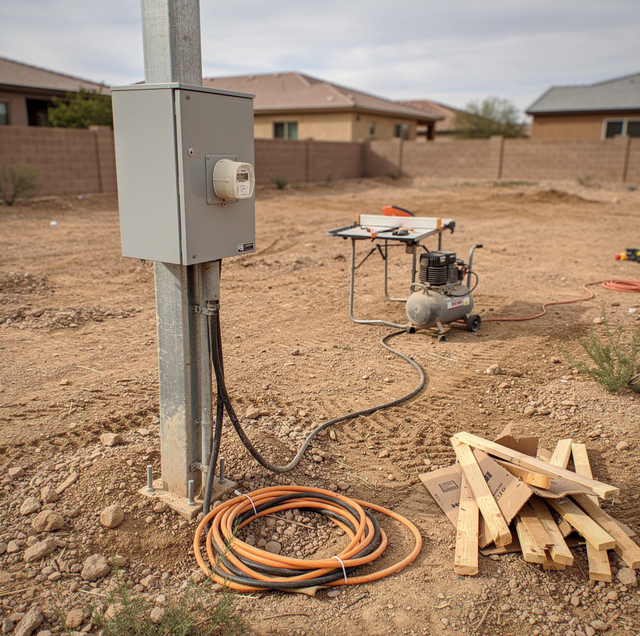
At the edge of the lot stands a post with a meter on it, a small panel bolted underneath, and four cords running off it across bare dirt to a table saw and a compressor. There is no building on it yet. Framing goes up over the next few weeks, then the roof, then the rough-in, and every one of those trades plugs into that post.
That post is your temporary power service. The utility feeds it from its own meter and account, and it comes down on the day your permanent service goes live. Everything between those two dates runs off it, and the decisions you make about it in your first week set what your site can do from then on.
At the Edge of the Lot, a Service of Its Own
A temporary power service is a post or pedestal set in the dirt with a meter socket at working height, a small breaker panel beneath it, and receptacles behind weather covers. The utility sets its own meter in that socket and opens an account against it. The whole assembly feeds a site that doesn't yet have its own service.
One utility's specifications specify a 6-by-6 treated timber set in compacted earth for the customer's temporary mounting structure and allow Schedule 40 steel pipe three inches in diameter or larger to be used instead of timber. That is one utility's document. The utility serving a given lot publishes its own, and the two do not have to match.
It goes in before the grading, the forms and the framing, so its spot is chosen for reach across the whole lot and for clearance from the excavation. Cords run out from it in every direction for months, and that spot has to keep working for you as your site changes shape around it.
The Separation of Responsibility Runs Through the Meter
One utility's own glossary defines the point of delivery as the location at which its electric facilities make contact with a customer's service equipment, and calls it the exact point at which responsibility for the construction, ownership, operation, and maintenance of all facilities, except metering equipment, is separated. The structure, the socket, the panel, the grounding and the cords sit on your side of that line. The meter itself is carved out by name and stays the utility's.
Another utility's installation standard says the same thing a different way in its temporary services section: the meter socket is furnished and installed by the customer. Two utilities, two documents, one split. On site, it means an electrician builds the assembly and keeps it working, and when a breaker on the pole will not hold at six in the morning, the number you call is the electrician's.
Built for Weather, Dust, and Getting Knocked Into
The pole stands in the open from your first week on the lot to your last. Sun sits on the enclosure all day, a film of grit settles on every surface, and a storm drives rain sideways at a box with no wall behind it and nothing over it. Then there is the traffic: a skid steer swinging past, a loaded wheelbarrow crossing the same cord twice an hour.
TIP: A Type 3R enclosure rating gets a degree of protection against falling dirt, limits the effects of rain, sleet, and snow, and is undamaged by ice forming on the enclosure itself. Open ground supplies all three.
Cords are the part that takes the abuse. They lie in the dirt, get dragged, get rolled over, and end up in standing water after an afternoon of rain. That is why a crew wires the receptacles on a temporary panel with GFCI protection and fits covers deep enough to close over a plugged-in cord, so a wet cord end opens the circuit at the panel while the tool is still in someone's hand.
Grounding is the part that has to be built out of nothing. A finished house bonds its grounding system to what the building already has: the rebar in the footing, the metal water line, the structural steel. On a bare lot, none of that is in place, so the temporary service drives its own electrode into the dirt beside the post and runs a conductor up to the panel. For the months that follow, that one rod is the site's entire path to earth. Every tool, every cord and every fault on the lot resolves through it, which is why an electrician checks the connection at the rod as carefully as the terminations inside the panel, and why a rod knocked loose by a machine gets reset before the next tool plugs in.
The Amperage Gets Settled at the Application
A utility's temporary electric service request asks for the service entrance section size in amps, whether the load is single-phase or three-phase, the voltage, the equipment load in horsepower, and whether the service comes in overhead or underground. Those answers are the sizing conversation, and the utility asks for them at the request, before anything is set in the ground.
Horsepower is asked for separately from the service size for a reason that is worth knowing. It is the utility's way of asking what motors will be on the site, because a compressor and a saw behave differently from lights and a trailer. If your tool list changes after the request goes in, the number you gave is the one the service was built to.
Two Connections, and the Gap Between Them
The temporary service is one request made to the utility. The permanent service is a second request, made later, with its own paperwork, its own gate, and its own date on the utility's calendar.
One utility publishes the order plainly: once an account has been established and clearance has been received from the authority having jurisdiction, the service lateral is energized, and installation of the meter is scheduled. Its own construction checklist puts the inspections and that clearance ahead of the connection in the same order. Another utility's standard says an inspection release is to be provided to the company by the local public authority before it energizes a new service.
Read that sequence closely, and the schedule risk shows itself. The utility does not energize on the day you ask; it energizes after someone else releases the work, and it then schedules the meter. That is a dated appointment you have to ask for in advance, and until it happens, your site is still running on the pole. A build that leaves the permanent request until the drywall is up has already spent its slack.
Booking It Before the Site Needs It
The pole is an electrician's build, and it belongs on the schedule just like the excavation. It is worth raising in the same conversation where you book the first trades, because a saw with nowhere to plug in is a crew standing in the dirt.
Treat the two connections as two separate line items, each with its own date. The permanent request goes in while the building is still being framed, so that the date exists before anyone needs it, and the temporary service carries the site until that date arrives.
Before any of it is ordered, someone walks your tool list and writes down what will be drawing at once: the saws, the compressor, the trailer, the site lighting, and the scissor lift charging overnight when nobody is on the lot, and nobody is picturing it as load. That total is the number the temporary service gets sized to.
Frequently Asked Questions
The site gets managed around the service you asked for. Crews stagger the heavy tools, run the lift charge overnight, and keep the trailer off the same leg as the saw. Upsizing means a new request and new dates from the utility, which is why the tool list is worth walking twice before you submit it. If your build adds a trade nobody planned for, your electrician wants to hear about it in the same week.
The electrician who built it. The utility owns the meter, and the connection to it, and everything from the socket outward is on the customer's side, so a dead receptacle, a tripped breaker, or a damaged cover is the electrician's work. A loss of power at the meter itself, or damage to the utility's line, is theirs. Knowing which side your fault sits on saves you the first hour of the call.
As long as your build takes. The term on a temporary account is the utility's to set, so that question belongs in your first call, but the permanent connection is what actually ends it. It is one of the few things on your site that gets longer every time the job slips, and the account stays open through every delay. The removal date you plan should follow the permanent connection rather than the original build calendar you started with.
Yes, because nothing else on the lot can do the job yet. Poured footing rebar is not yet connected to anything, the water line may not be in the ground, and there is no structural steel. The electrode driven beside the post is the only connection to earth on the site, and it will remain the only one until the building has a grounding system of its own. That is worth knowing before you place the post.
It can, though the work is closer to setting a new one than to moving a cord. The structure comes out of compacted earth, the electrode moves with it, and the utility has to be brought back in, because its meter and its connection sit on your assembly. You are better off choosing a spot that survives the excavation, the slab, and the material drops than planning to move your pole later, and the plan usually shows one.
After the permanent one is live, and that is a separate step with its own date. The utility's sequence places an account and a clearance from the authority having jurisdiction ahead of energizing, with the meter installation scheduled afterward, so your permanent connection appears on your calendar as a booked appointment. Once it is energized, the electrician removes the structure, and the utility recovers its metering equipment, which its definitions keep on the utility's side of the line.
A temporary service has to be requested before the trades that depend on it are booked — the utility's own published steps sit between that request and the day the site has power, so the electrician who will build it belongs in the schedule conversation from the very start. Efficient Electric serves Phoenix, Peoria, and the surrounding West Valley. Call (623) 810-9905.