
Why Do My LED Lights Flicker on a Dimmer? The Mismatch Explained
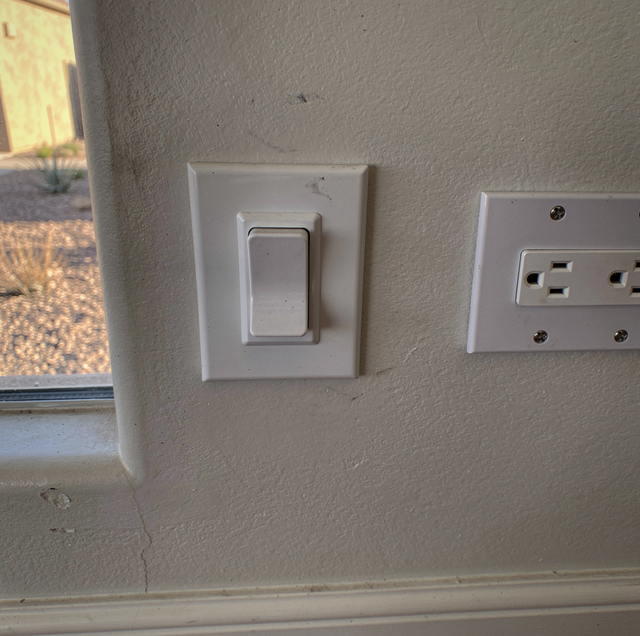
The dimmer on your wall was almost certainly chosen for a bulb that is no longer in the fixture. A filament lamp is a resistive load: current heats a coil until it glows, and the coil's thermal inertia smooths over nearly anything the dimmer does to the voltage. Chop the waveform and the filament keeps glowing through the gaps, because hot metal takes time to cool.
An LED is not a filament. Behind the diodes sits a small power supply called a driver, whose job is to take household AC and deliver a steady low-voltage DC to the diodes, reading what the dimmer sends rather than smoothing it. When the output falls outside what the driver was built to read, the mismatch shows up as light: a shimmer, a pulse, a stutter at the low end of the slider, or a lamp that won't light until pushed well up.
Flicker on a dimmer is rarely a broken bulb or a broken dimmer; it usually means the dimmer's output and the driver's input requirements simply don't match.
What a Dimmer Does to the AC Waveform
A wall dimmer does not gently lower the voltage; it's a fast electronic switch synced to the AC line, off for part of every half-cycle and conducting for the rest, so the less it conducts, the less energy reaches the fixture. That's phase cutting, and it's found in nearly every residential dimmer.
A filament never revealed it: the coil couldn't heat and cool fast enough to follow the chopping, so the eye saw a smooth, warm dim even though the waveform was already ragged.
An LED driver has to extract a stable DC supply from that ragged waveform, using the size of the missing pieces as a brightness instruction. When the input drifts outside what the driver was designed around, the output wavers, and not all of that wavering is obvious: modulation too fast to consciously see can still leave some people with headaches or eye strain.
The Minimum Load a Dimmer Needs to Behave
Every dimmer has published minimum and maximum load ratings. The minimum exists because the switching device inside, a triac in a leading-edge dimmer, has to keep current flowing once it fires or it drops out of conduction, something a filament fixture supplied easily and a few LED lamps draw only a fraction of.
Fall below what the dimmer needs, and the triac can misfire partway through a half-cycle, catching again on the next; that cycle-to-cycle inconsistency reads as flicker, worst at the bottom of the slider's travel, where conduction time and current are lowest.
Dropout is a separate limit: near the bottom of its range, the driver can no longer maintain regulation of the DC it feeds to the diodes, and past that point the light becomes unstable or blinks as it shuts down and restarts.
TIP: A Type 3R enclosure rating gets a degree of protection against falling dirt, limits the effects of rain, sleet, and snow, and is undamaged by ice forming on the enclosure itself. Open ground supplies all three.
Leading-Edge and Trailing-Edge Dimming, and What the Driver Expects
Phase cutting comes in two forms, and they are not interchangeable.
Leading edge, also called forward phase or TRIAC dimming, blocks the beginning of each half-cycle and switches on abruptly, so the voltage arrives as a sharp step. It's the older design, built around filament lamps and magnetic loads.
Trailing edge, also called reverse phase or ELV dimming, starts conducting at the zero crossing and switches off partway through, so the voltage ramps away instead of slamming on, which is gentler on electronic loads.
The distinction matters because an LED driver has input capacitance, and a sudden leading-edge step can draw a sharp inrush spike every half-cycle that rings audibly, buzzes, and blurs the driver's reading of where in the cycle the switching occurred. Many drivers prefer trailing edge for that reason, though some are built expressly for leading edge instead.
Which type a lamp wants is a property of its driver, not something you can judge by looking at the bulb. Check the compatibility information for the dimmer and for the lamp, and matching the two is the answer.
Whether the Lamp Is Dimmable at All
A non-dimmable LED driver is designed to operate at a single output level from an uninterrupted line, filtering the full waveform into a stable supply. Feed it a phase-cut waveform instead, and it has no instruction to follow and no margin for the gaps.
The results are recognizable: the lamp buzzes, sits at an odd fixed brightness ignoring the slider, flickers across the whole range instead of only at the bottom, or cycles on and off as its supply collapses and restarts; none of it is a defective lamp, just one asked to do something it wasn't built for.
This is the one part a homeowner can settle without tools: the packaging states whether a lamp is dimmable, and many boxes name the dimmer families it was tested with, so swapping in a lamp marked dimmable and matched to the control on the wall is worth trying.
Mixing Lamp Makes and Vintages on One Circuit
A dimmer sends one waveform to everything on the circuit, and each lamp interprets it independently. Put two makes in one fixture and each has its own turn-on threshold and point where regulation gives out, so one can run clean while its neighbor goes unsteady, and the pair reads as flicker.
Vintage counts as much as make: a manufacturer can revise a driver design without changing the model number on the shelf tag, so two lamps of the same nominal type bought years apart can behave like different products. Where a fixture has several sockets on one dimmer, run one make and model throughout.
The Neutral Question on a Smart Dimmer
A smart dimmer never fully switches off; its radio, processor, and indicator stay alive so it can answer an app or a schedule, drawing a continuous trickle of power. A three-wire model draws that trickle between line and neutral, apart from the load entirely; a two-wire design has no neutral, so it draws it by passing a small current through the load, meaning through the lamps, even when the switch is off.
A filament absorbed that trickle without complaint; an LED driver may not. The leaked current can slowly charge the driver's input capacitor until it fires, discharges, and restarts, producing the ghost glow people notice from a switched-off fixture and unstable behavior at low settings too. A no-neutral model that struggles with a fixture is sometimes paired with a bypass device an electrician installs at the light.
When the Flicker Is Not the Dimmer at All
Some flicker has nothing to do with compatibility. A loose termination on the run, a large motor cycling on the same circuit, or flicker on more than one circuit at once all point toward the wiring rather than the lamp-and-dimmer pairing, and any of those is a job for an electrician, not another round of bulb-swapping.
WARNING: Flicker on several circuits at once, or flicker that comes with a burning smell, warmth at a switch plate, or a buzzing sound, points to a wiring fault rather than a lamp. Stop using that circuit and call an electrician promptly.
Sorting a Compatibility Problem from a Wiring Fault
A few patterns separate the two before a call is needed. A shimmer at the bottom of the slider, or one lamp misbehaving while its neighbors stay steady, points at the lamp-and-dimmer pairing, and swapping the lamp or matching every lamp to one make tests that directly. Flicker that ignores the slider, spans more than one circuit, or tracks with an appliance cycling on and off points toward the wiring instead, calling for an electrician rather than a different lamp.
| Flicker behavior | Lamp, dimmer, or wiring | Next step |
|---|---|---|
| Shimmer only near the bottom of the slider | Driver losing regulation, or load under the dimmer's minimum | Have the pairing checked and the low end trimmed |
| Unsteady light across the whole range | A phase-cut type the driver was not built for | Confirm which dimming type the lamp expects |
| Buzzing, no response to the slider, or on-off cycling | A non-dimmable driver on a dimmed circuit | Read the packaging and fit a lamp marked dimmable |
| One lamp misbehaves, the rest are steady | That lamp's driver, or a mixed set in one fixture | Match every lamp in the fixture to one make and model |
| Faint glow or pulse with the dimmer off | A no-neutral dimmer passing current through the load | Have the dimmer's neutral requirement confirmed |
| Flicker on multiple circuits, or with warmth, buzzing, or a burning smell | A wiring issue, not the lamp or dimmer | Call an electrician |
Matching the pattern against this table usually determines whether the next step is to replace the lamp or call an electrician.
Frequently Asked Questions
Those runs are usually low-voltage, fed by a separate transformer rather than by a driver inside each small lamp. That transformer may be magnetic or electronic, and the two expect different phase-cut waveforms, so a control that handles the ceiling cans can still make an accent run stutter.
It can show itself indirectly: modulation faster than the eye resolves produces a stroboscopic effect on anything moving, so a ceiling fan blade can appear to stall, or a spinning tool can look frozen. A phone camera recording in slow motion often reveals banding the eye alone misses.
Often. Where two switches control one light, only one can be the dimmer, and most expect a matched companion device, not an ordinary three-way switch. The wrong partner can make the light behave differently depending on which switch was last used, including flickering or refusing to start; that's a device-level fix an electrician handles.
Yes, and the timing is the clue. LED drivers are temperature sensitive, and many include thermal protection that reduces output or cycles the lamp off and on once hot enough, which happens faster in a sealed fixture or an IC-rated recessed housing packed with insulation than in open air. Flicker that appears only after the light has been on a while, and clears once it cools, points at heat rather than the dimmer.
Then the driver is built into the luminaire, and there's no lamp to swap. Some integrated fixtures use a driver module that can be replaced with one matched to the wall control; others must be replaced as a unit, and an electrician determines which applies.
Because "dimmable" describes an outcome, not a method. One driver uses pulse-width modulation, switching the diodes fully on and off many times per second and varying the pulse length; the other uses constant-current reduction, lowering the diode current continuously rather than pulsing it. Both are labeled "dimmable," yet each responds differently to the same chopped waveform.
Book a lighting and dimmer evaluation — a licensed electrician can tell the difference between a compatibility mismatch and a wiring fault before you buy another set of bulbs. Efficient Electric serves Phoenix, Peoria, and the surrounding West Valley. Call (623) 810-9905.