
Aluminum Wiring in Older Homes: What Fails and How to Fix It
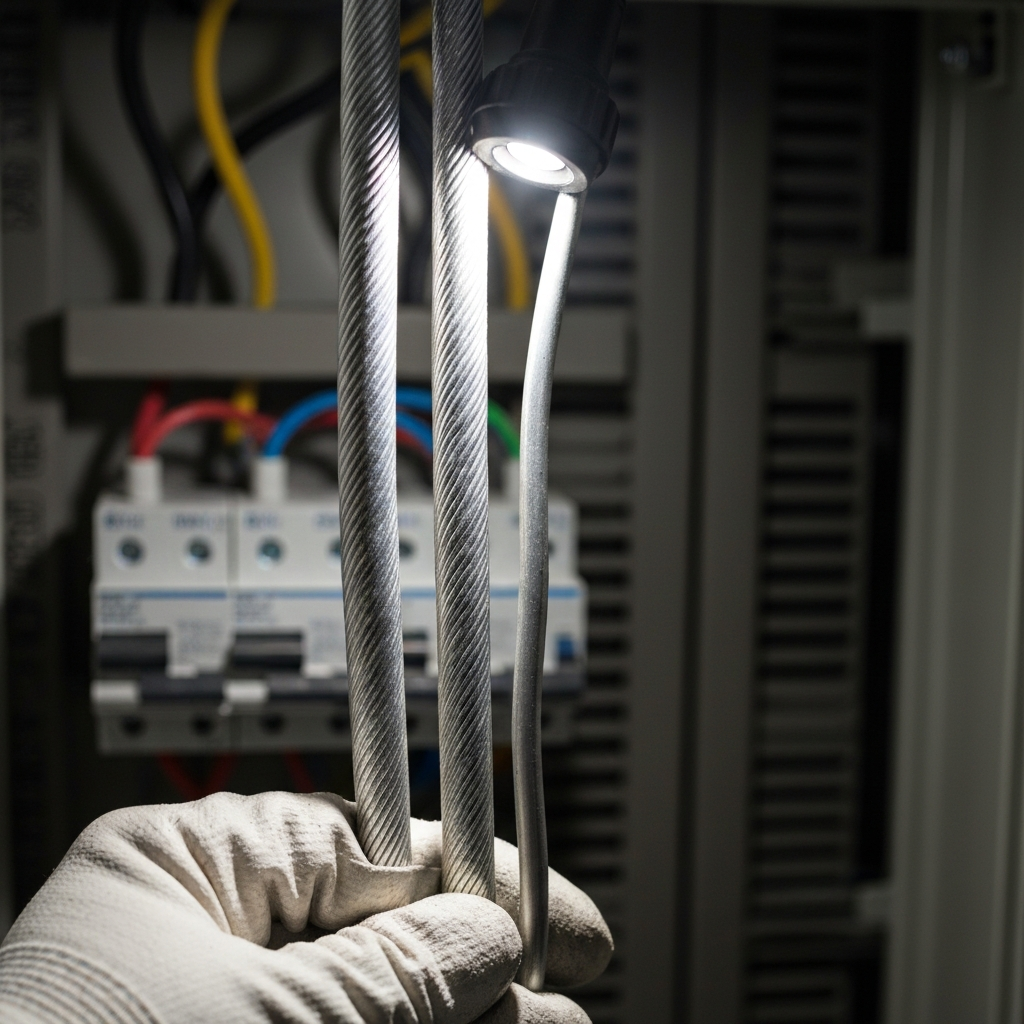
You rest your hand on a light switch in an older home, and the cover plate feels faintly warm, warmer than a switch that has only been flipped a few times all evening should be. Or you catch a thread of hot-plastic smell near an outlet with nothing plugged into it, there and then gone before you can place it. In a house built in the late 1960s or early 1970s, small signals like that often trace back to one thing sitting behind the wall: solid aluminum branch wiring, and the points where it ties into your switches, outlets, and light fixtures.
Aluminum on a branch circuit is not a fire waiting to happen the second you notice it. The metal carries current safely along its length, just as it does in the large feeders that still serve many ranges, dryers, and service panels today. The trouble lives at the ends, where the wire meets a screw terminal or a splice inside a box. That is both the bad news and the good news. The bad news is that every connection in the house is a place where things can drift out of tolerance. The good news is that connections can be repaired, one by one, without pulling the wire out of finished walls.
Why So Many 1960s and 1970s Homes Have It
For a stretch running roughly from 1965 to 1973, copper prices climbed hard, and builders reached for a cheaper conductor. Solid aluminum wire went into millions of homes on ordinary 15- and 20-amp branch circuits, the circuits that feed your receptacles, wall switches, and lighting. The early alloy used in that era was essentially a utility-grade aluminum that behaved differently than the copper electricians were used to, and the connection hardware of the day was not designed around its quirks.
It helps to separate two very different uses of aluminum. Large stranded aluminum conductors that feed a service panel, an electric range, or a central air-conditioning unit are still used today and are considered sound when properly terminated. The concern with older homes is the solid, single-strand aluminum on general-purpose 15- and 20-amp circuits. That is the wiring that developed a reputation, and it is what an electrician is looking for when they open a device box and find a dull gray conductor instead of the reddish tone of copper, often with "AL" or "ALUMINUM" printed on the cable jacket.
Where Aluminum Connections Go Wrong
Understanding the fix starts with understanding the failure, and it is not one problem but several stacking on top of each other at the connection point.
Start with oxidation. Aluminum reacts with air and forms a thin skin of aluminum oxide almost immediately. Unlike the oxide that forms on copper, aluminum oxide is a poor conductor, closer to a ceramic than a metal. Where that film builds at a terminal, it acts like a small resistor buried in the connection, and resistance turns current into heat.
Then there is movement. Aluminum expands and contracts more than copper for the same change in temperature, and it also moves more than the steel or brass of the screw and terminal clamping it. Every time a circuit draws a load, the wire warms and grows; when the load drops, it cools and shrinks. Over the years of that cycling, the wire works itself a little looser against the terminal. Heavy, sustained draws make the cycling more pronounced, so a home running its air conditioning hard through a long cooling season will flex those connections more in those months. However, the same expand-and-contract fatigue happens on a smaller scale in any season a circuit is used.
On top of that sits a property called cold creep, or cold flow. Under the steady squeeze of a terminal screw, aluminum slowly deforms and migrates out from under the pressure, the way a soft metal gives over time. The screw that was snug at installation is no longer holding the wire as tightly a decade later. Add a little galvanic corrosion wherever aluminum meets a dissimilar metal in the presence of humidity, and the connection keeps loosening.
Each of these pushes in the same direction: a looser joint, higher resistance, more heat at that one spot. Heat accelerates oxidation and creep, which further raises resistance and makes more heat. That feedback is why a bad aluminum connection can run cool for years and then char a receptacle, a switch, or the wire insulation behind a cover plate. The failure builds at the termination, which is exactly why a warm plate or a faint plastic smell at a specific outlet is worth taking seriously rather than waiting for a breaker to trip.
The Fixes That Actually Hold
Because the problem lies in the connections, the accepted repairs all target the connections. They differ in how thoroughly they solve it and in what they ask of you in labor, box space, and disruption. Four approaches are worth knowing.
COPALUM crimp: This is a copper pigtail joined to the aluminum wire with a specially engineered metal sleeve, compressed by a calibrated hydraulic tool so tightly that the two metals cold-weld into a gas-tight bond, then covered with an insulating sleeve. The copper tail is what lands on the device. It is widely regarded as a permanent repair because the crimp does not rely on a screw staying tight over time. The catch is access: the tool is licensed, the technicians who can operate it are certified and not common everywhere, and it requires enough slack wire and box room to work. Every connection in the house has to be done individually.
AlumiConn connectors: These are small three-port lug connectors that clamp the aluminum wire and a copper pigtail under separate set screws torqued to a specified value, with an oxide-inhibiting compound inside, so the two metals never share the same clamp. They do not need the licensed COPALUM tooling, only a torque screwdriver and correct technique, which makes them easier to source and install. They are bulkier than a wire nut, so box fill and space matter, and like every method here, they have to be done at each connection with the torque set right.
Pigtailing to copper with rated devices: Here, the aluminum is spliced to a short copper pigtail using an approved connector and antioxidant paste, and the receptacles and switches are replaced with ones marked CO/ALR, a rating designed to handle aluminum directly at the binding screw. Two cautions go with this route. Ordinary twist-on wire nuts, including the purple ones sold for aluminum-to-copper connections, have a mixed track record and are not considered a reliable permanent splice by safety testers, so the choice of connector matters. And CO/ALR devices only exist as receptacles and switches, so they do nothing for splices buried in junction boxes or the connections up at ceiling light and fan fixtures, which still need a proper connector. Push-in "backstab" terminals should never be used with aluminum.
Full rewire: Replacing the aluminum branch circuits with new copper removes the root cause entirely and leaves nothing to re-inspect later. It is also the most invasive path, since it means fishing new cable through finished walls and ceilings and opening drywall where the wire cannot be pulled, which is why it is often folded into a larger remodel rather than done on its own. When walls are already open, it is often the simplest long-term answer.
| Repair method | What it does | The tradeoff |
|---|---|---|
| COPALUM crimp | Cold-welds a copper pigtail to the aluminum with a calibrated tool. | Certified installers and the licensed tool are scarce; needs box space and slack. |
| AlumiConn connector | Clamps aluminum and a copper pigtail under separate torqued set screws. | Bulky in the box; each set screw must be torqued correctly. |
| Pigtail + CO/ALR devices | Splices to copper and swaps in devices rated for aluminum. | Does not cover junction-box splices or fixture connections; connector choice matters. |
| Full rewire in copper | Removes the aluminum branch circuits entirely. | Most invasive and disruptive; usually paired with a remodel. |
A thread runs through all four: the repair is only as good as the workmanship at each joint. Correct torque, the right connector for the wire, an oxide inhibitor where the method calls for it, and enough room in the box are what separate a lasting fix from one that loosens again. This is close, patient work at many individual points, not a single dramatic swap, which is a large part of why an evaluation starts with an electrician actually opening boxes rather than guessing from the panel.
How to Decide Which Fix Fits
The choice usually comes down to how the home is built, how much of it is open, and how permanent you want the answer to be. In a finished home you plan to keep, remediating every connection with COPALUM or AlumiConn addresses the hazard where it lives without gutting the walls, and it is the route many homeowners land on. If you are already down to the studs in a remodel, running new copper can make more sense because the hard part, opening the walls, is done anyway. Pigtailing with CO/ALR devices can be part of a plan, but only when someone accounts for the connections those devices cannot reach.
What does not work is a partial, cosmetic pass: swapping a few discolored outlets and calling it finished. The connection that overheats next may be the one nobody opened, at a switch that felt fine or a splice tucked into a ceiling box. A repair that skips connections leaves the exact failure mode it was meant to solve.
Frequently Asked Questions
Not bad, but more demanding. Hard water builds scale inside a tankless unit's heat exchanger, which hurts performance and life if it's not descaled regularly. With periodic descaling and ideally a water softener, a tankless unit works well in hard water and reaches its long lifespan. Without that maintenance, it can underperform and wear out early.
Yes. Hard water deposits sediment at the bottom of a tank, which insulates the burner, slows reheating, reduces capacity, and stresses the steel. Regular flushing clears it and protects the heater. A tank is somewhat more forgiving of missed maintenance than a tankless unit, but hard water still shortens its life if it's never flushed.
A tankless unit has a longer potential lifespan—often 20 years or more, versus 8 to 12 for a tank—but only if it's descaled and paired with a water softener. With proper maintenance, tankless generally outlasts a tank even in hard water.
It's strongly recommended in hard-water areas. A softener removes the minerals that build scale inside the heat exchanger, protecting the unit and reducing how often it needs descaling.
The harder the water, the more often it should be descaled. Many manufacturers recommend annual descaling, but very hard water may require it more frequently.
If you're willing to maintain it and treat the water, a tankless unit offers better long-term value. If you prefer lower upfront cost and minimal maintenance, a traditional tank may be the better fit.
Making Aluminum Wiring Safe to Live With
Aluminum branch wiring earned its reputation at its weakest point, the connections, and that is also where the reputation can be retired. The wire threading through your walls is not the enemy; the loose, oxidized, heat-cycled joints at its ends are. Whether the right move is crimping copper pigtails onto every connection, stepping up to rated connectors and devices, or rewiring during a larger project, the goal is the same: make every termination in the house tight, cool, and stable, and keep it that way. An electrician who opens the boxes, reads what the connections are actually doing, and matches the method to the house is worth far more than a quick guess from the panel door.
Have an older home with aluminum wiring, or a warm cover plate you cannot explain? Book an inspection and get every connection checked and repaired properly. Efficient Electric serves Phoenix, Peoria, and the surrounding West Valley. Call (623) 810-9905.