
Why Does My GFCI Outlet Keep Tripping? What It's Warning You About
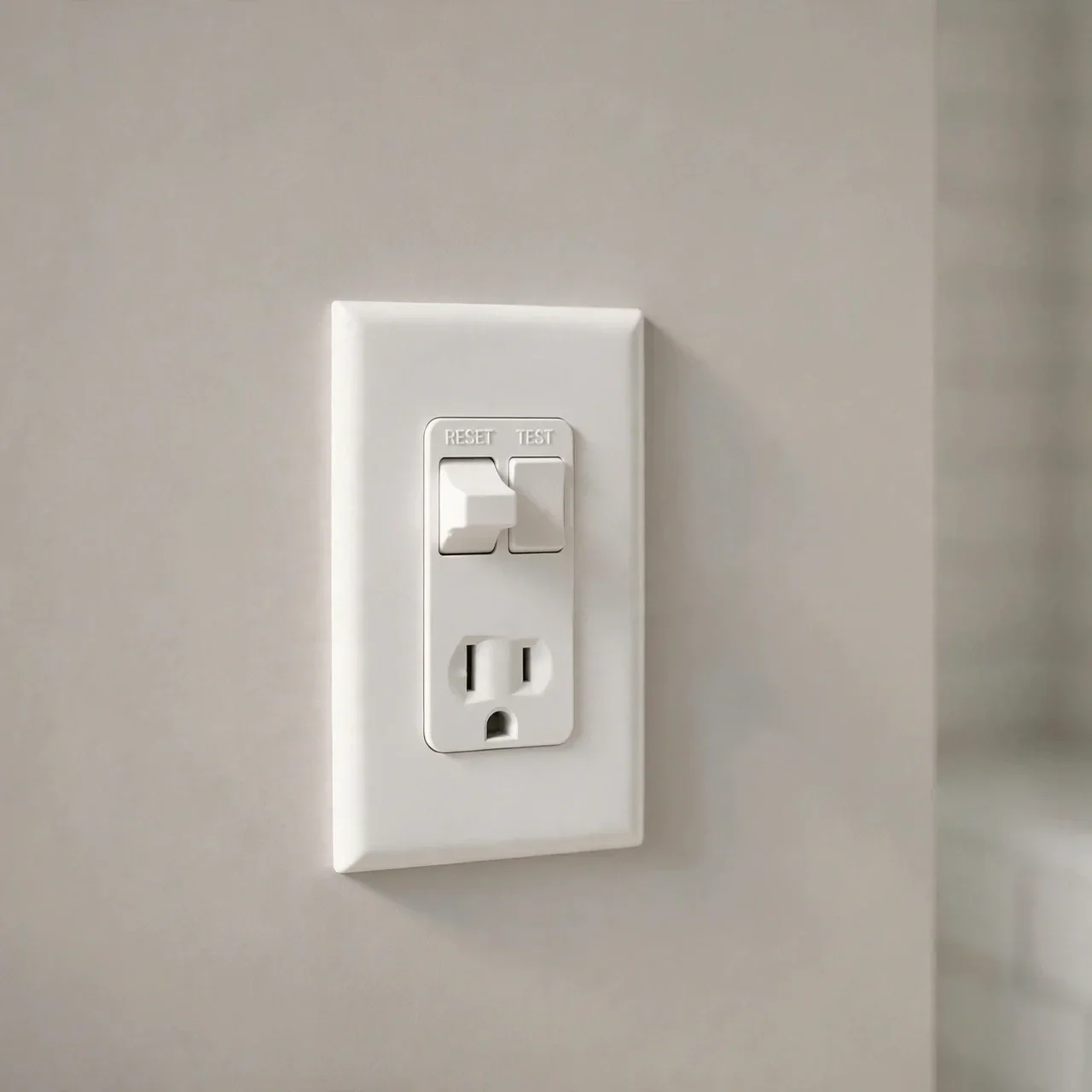
You go to plug in the hair dryer, and the bathroom outlet is dead. The little reset button in the middle has popped out. You push it back in, it clicks, holds for a second, then snaps out again. Same story at the garage workbench, or the outdoor receptacle by the patio where the string lights used to run. The outlet looks fine. Nothing is smoking. But that button will not stay in, and now a whole run of outlets downstream is dead with it.
A GFCI is not being temperamental when it does this. It is the one device in your house built to cut power the instant something is wrong, and a recurring trip means the fault is still there. The trick is reading what kind of fault it is, because some are a five-minute nuisance, and one or two are the reason the outlet exists at all.
What a GFCI Is Actually Watching
A ground-fault circuit interrupter does one job, and understanding it makes every trip easier to diagnose. Inside the device, the hot and neutral conductors both pass through a small current sensor. In a healthy circuit, every bit of current that flows out on the hot wire returns on the neutral. The two are equal, and the sensor sees nothing.
A GFCI is watching for the moment when they stop being equal. If current leaves on the hot and some of it does not come back on the neutral, that missing current is going somewhere it should not, through water, through damaged insulation, through a person. That escaped current is a ground fault. When the imbalance reaches roughly 4 to 6 milliamps, a hair of a load, the device trips in a fraction of a second. That threshold is deliberately tiny. It is set below the level that would stop a human heart, which is why these are required in bathrooms, kitchens, garages, and every outdoor and wet location.
So the outlet is not measuring overload the way a breaker does. A breaker trips on too much total current. A GFCI trips on a mismatch between what is left and what is returned, even a few thousandths of an amp. That distinction is the whole key to figuring out why yours keeps going.
Start by Reading How It Trips
Before pulling anything apart, watch the pattern. When the GFCI trips, and whether it will reset with nothing plugged in, narrows the cause faster than any tester. Here is how the common patterns line up.
| What you're seeing | What it usually means | What to do |
|---|---|---|
| Resets fine, then trips only when one appliance runs | That appliance is leaking current to ground | Unplug it and test the outlet; have the appliance checked or retired |
| Trips after rain or in a damp box, dries out, and holds | Moisture bridging the terminals | Confirm the cover seals; a wet receptacle may need drying or replacing |
| Won't reset at all, nothing plugged in | Fault on the device or its wiring, or a dead GFCI | Stop resetting; the circuit needs to be traced |
| Trips randomly under heavy or hot-weather load | Cumulative leakage or a marginal connection | Have the load and the terminations checked |
| Several outlets die with one reset | Those outlets are downstream on the LOAD terminals | Find and reset the upstream GFCI first |
That last row surprises people. One GFCI usually protects a string of ordinary outlets wired to its LOAD terminals, so a fault three rooms away can be what is popping the button you are standing at. Sort the pattern first, then the cause below will match one of a handful of real problems.
Moisture Is the Most Common Culprit
Water conducts, and a GFCI is built to notice. When moisture works into an outdoor box, a garage receptacle, or the wall behind a splashed bathroom outlet, it gives current a faint path from the hot terminal to ground. That path might only leak a few milliamps, invisible to you, but it is exactly what the device is watching for.
Outdoor outlets are the usual offenders. A flat weatherproof cover that only seals when nothing is plugged in does nothing for a cord left out in a storm. The fix there is a bubble-style in-use cover, the deep, clear lid that closes over a plugged-in cord and keeps driving rain off the face of the receptacle. Blowing dust and grit matter too, since a dirty, damp receptacle face conducts better than a clean, dry one. If the trip clears once everything dries and comes back the next time it rains, moisture is your answer, and the cover or the receptacle is where to look.
A Downstream Outlet Doing the Tripping
This is the cause most homeowners never find on their own. A single GFCI has two sets of screws. The LINE terminals take the incoming power. The LOAD terminals send protected power to other ordinary outlets down the circuit. Every receptacle fed from those LOAD terminals is guarded by that one GFCI, even though it has no reset button of its own.
That means a fault anywhere on the downstream run trips the GFCI you are looking at. A cracked receptacle in the garage, a pinched cable behind a wall, or a neutral that accidentally touches a ground or a box screw somewhere along that run all create the imbalance. A stray neutral-to-ground bond is a classic one: if the white wire on a downstream outlet contacts the metal box or gets crossed with another circuit's neutral, return current splits, and the sensor reads a mismatch. Miswiring is another. If an installer put the incoming wires on the LOAD side by mistake, or crossed neutrals between two circuits, the device can trip immediately or refuse to hold. Tracing which outlets go dead together maps the protected run, and that map points to where the fault lives.
When One GFCI Is Carrying Too Much
Sometimes nothing is broken, and the outlet still trips. Every appliance and every long cable run leaks a tiny amount of current to ground as normal behavior. Manufacturers are allowed a small leakage per device, often around half a milliamp, and long wiring runs add a little capacitive leakage of their own. Put enough outlets, a freezer, a battery charger, and a couple of hundred feet of downstream cable on one GFCI, and those harmless fractions add up. On a warm afternoon with more running at once, the total can drift past that 4-to-6 milliamp line and trip a device that has nothing actually wrong with it.
Motor-driven appliances make this worse. A garage freezer, a sump or pool pump, or a shop vac draws a hard inrush each time the motor kicks on, and the electrical noise from that startup can look enough like a fault to trip a sensitive GFCI. This is why a chest freezer in a shared garage GFCI trips seemingly at random, usually catching you after it has thawed. The honest fix is often a dedicated circuit for the heavy appliance, so it is not sharing leakage headroom with half the garage. Heat plays a quiet role too: long runs of high current in a hot garage or attic stress terminations, and a loosening connection will leak and trip sooner under peak summer load, though the same weak connection is there in any season.
A Worn-Out or Failing GFCI
GFCIs do not last forever. The internal electronics that monitor the current balance wear out, and a device near the end of its life can start tripping on nothing or refuse to reset even with the circuit clear. Age, heat, and nearby surges from storms or grid switching all shorten that life. A receptacle that has quietly protected a bathroom for fifteen years has earned its retirement.
Newer GFCIs actually test themselves. Devices built in recent years run an automatic self-check, and if that internal test fails, many are designed to trip or lock out rather than remain in a state where they no longer protect you. So, a GFCI that suddenly will not reset, with nothing plugged in and no downstream fault you can find, may simply have failed its own test and be doing exactly what it should: refusing to pretend it is working. Pressing the TEST button monthly is worth the habit, since a GFCI that does not trip when you test it, or does not reset afterward, is telling you the same thing. The device gets replaced, not coaxed.
When a Tripping GFCI Is a Real Warning
Most repeat trips trace back to moisture, a tired device, or too much sharing one circuit. But the reason a GFCI trips at 4 to 6 milliamps instead of waiting for a breaker's fifteen or twenty amps is that it is guarding against shock, not overload. When it trips the instant a specific appliance runs, that appliance may have a genuine internal fault sending current to its metal housing, and the outlet just stopped that current from finding you first. Treat a repeat trip as information, not an inconvenience to defeat.
The move that turns a nuisance into a hazard is bypassing the protection. Swapping a GFCI for an ordinary receptacle to stop the tripping, or hunting for a non-protected outlet to run the same appliance, removes the one thing standing between a fault and a person. If you cannot find why it trips, or if it trips alongside a warm cover plate, a burning smell, or visible scorching, that is the point to stop resetting and have the circuit traced. A GFCI is worth listening to precisely because it interrupts long before anything else in the house notices a problem.
Working Back to the Cause
A GFCI that keeps tripping is running the same test over and over and getting the same answer: current is going somewhere it should not. Your job is to read which version you have. A trip tied to one appliance is that appliance. A trip tied to weather is moisture and a cover. A run of dead outlets points upstream to the LOAD side. A device that will not hold with a clean circuit is usually done. The rare case, a repeat trip you cannot explain or one paired with heat or odor, is the one the outlet was truly built for, and it is worth a professional set of eyes rather than one more push of the button.
Frequently Asked Questions
Unplug everything on the circuit and press reset. If it holds with nothing plugged in and only trips when a specific item runs, the fault is in that appliance or its cord, not the device. If it will not hold even with the circuit empty and no downstream outlets involved, the GFCI itself or its immediate wiring is the more likely problem. A plug-in receptacle tester with a GFCI trip button can also confirm whether the device responds correctly.
A GFCI receptacle only protects itself and whatever is wired to its LOAD terminals, so it will not trip because of a separate circuit. But some homes use GFCI breakers at the panel instead of outlets, and a GFCI breaker protects everything on that run. If you cannot find a reset button anywhere on a dead circuit, check the panel for a breaker with its own small test button. That is the reset.
Motor inrush and the electrical noise of a cycling compressor are what nudge a sensitive GFCI over its threshold, but the fix worth knowing is how to keep a trip from costing you the food. A chest freezer is best on its own dedicated 20-amp single-outlet (simplex) circuit, so nothing else on that run adds leakage or shares the trip. Pair it with an independent power-loss and temperature alarm, battery-powered or Wi-Fi, so a quiet nuisance trip signals you within minutes instead of announcing itself as a thawed puddle days later. A modern self-testing GFCI can help too, since some newer designs tolerate normal motor startup noise better than the older receptacles that nuisance-trip on inrush.
No. In bathrooms, kitchens, garages, laundry areas, and outdoor and wet locations, the protection is there because those spots put people near water and grounded surfaces. Removing it to silence a trip leaves a real fault live and a person unprotected. If the tripping is a nuisance from cumulative load, the answer is more circuit capacity or a dedicated line, not less protection.
There is no hard expiration date, but many electricians treat 10 to 15 years as a reasonable service life, sooner in hot garages, humid baths, or outdoor boxes where heat and moisture age the electronics faster. The clearest signal is the monthly test: if pressing TEST does not cut power, or the device will not reset afterward, it has failed and should be swapped regardless of age.
A GFCI watches for current leaking to ground to prevent shock. An AFCI watches for the erratic signature of arcing, the sparking at a loose connection or damaged wire that can start a fire. They guard against various dangers, and many circuits now use dual-function devices that perform both functions in a single unit. If your outlet trips, knowing which type you have matters, since an arc-fault trip and a ground-fault trip point at very different underlying problems.
If a GFCI keeps tripping and you cannot find the fault, have the circuit traced before you lose the protection you need. Efficient Electric serves Phoenix, Peoria, and the surrounding West Valley. Call (623) 810-9905.