
GFCI vs. AFCI: One Prevents Shock, the Other Prevents Fire
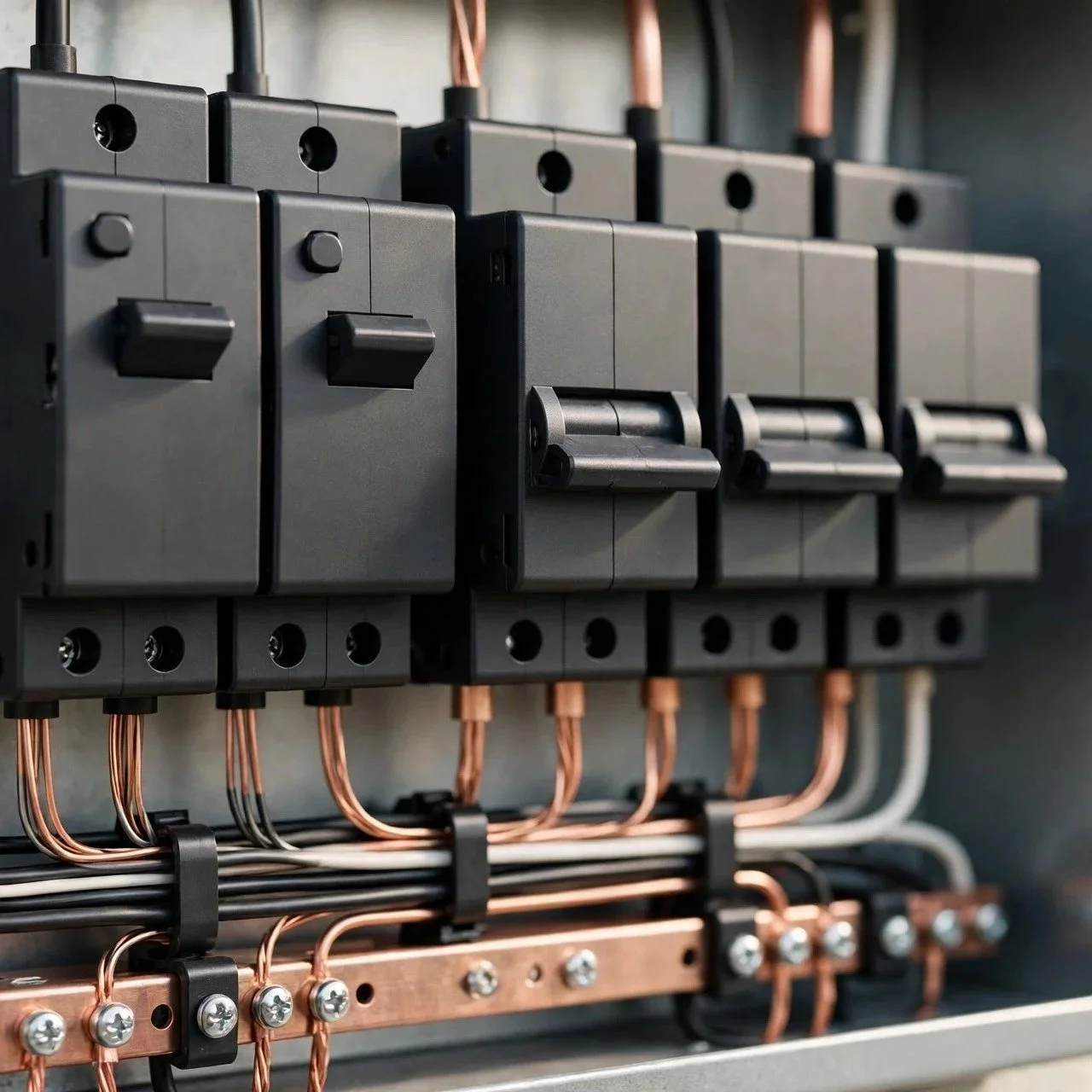
Two small buttons, two acronyms that look nearly identical stamped on a breaker, and a lot of homeowners file GFCI and AFCI under the same heading: "the safety outlet." They are not the same thing. They watch for two different faults, sense them in two different ways, and belong in different rooms. The receptacle that keeps you from a shock at the bathroom sink does very little to stop the kind of fault that smolders inside a wall, and the breaker built to catch that hidden fault is not what stands between you and the water. Knowing which one you have, and which one a given spot actually needs, is worth a few minutes.
Start with the fault each one is hunting, because the mechanism is the whole difference.
How a GFCI Senses a Ground Fault
A ground-fault circuit interrupter watches the balance between two wires. The hot conductor and the neutral conductor both pass through a small sensing ring inside the device. In a healthy circuit, all the current that leaves on the hot returns on the neutral, and the two cancel out. The sensor sees nothing to react to.
The moment some of that current stops coming back, the GFCI acts. If electricity finds another path to ground, through a wet countertop, a frayed cord lying in a puddle, or a person touching a faulty appliance, the current going out no longer matches the current returning. When that imbalance reaches roughly 4 to 6 milliamps, a few thousandths of an amp, the device cuts power in a fraction of a second. That threshold is set deliberately low, below the level that can stop a heart, which is why ground-fault protection lives wherever people and water meet: bathrooms, kitchens, laundry areas, garages, basements, and every outdoor receptacle. A GFCI is a people-protector first. It is indifferent to how much total current a circuit draws; it only cares whether any of it is escaping.
How an AFCI Reads the Signature of an Arc
An arc-fault circuit interrupter is solving a completely different problem. It is not looking for leaking current. It is listening for the electrical fingerprint of a spark.
An arc is current jumping a gap it should not, and it throws off heat far beyond what the surrounding materials can take. Two kinds matter. A series arc happens along a single conductor that has been nicked, cracked, or worked loose at a terminal, so the current has to jump a break in its own path. A parallel arc jumps between two conductors, hot to neutral or hot to ground, often where a staple has bitten through insulation or a nail has found a cable behind drywall. Both throw off intense, localized heat that can ignite wood framing, paper insulation, or dust long before enough current flows to trip an ordinary breaker.
This is where the AFCI earns its complexity. Normal household life is full of harmless arcs: the tiny spark when you flip a light switch, the brushes inside a vacuum motor, the contacts in a thermostat. An AFCI cannot simply trip on any spark, or your lights would go dark every time you used them. Instead, it carries a small processor that reads the shape of the current waveform hundreds of times a second, looking for the erratic, high-frequency pattern a dangerous arc produces and separating it from the ordinary ones. That pattern recognition is why an AFCI is an electronic device with a brain rather than a simple sensing ring, and why it protects the parts of a home where fires tend to start inside concealed wiring: bedrooms, living rooms, hallways, and most general-purpose circuits.
GFCI and AFCI Side by Side
The two devices are easiest to keep straight when you line up what each one is actually doing.
| GFCI | AFCI | |
|---|---|---|
| Hazard it detects | Ground fault: current leaking off the circuit toward ground, the cause of shock and electrocution | Arc fault: sparking at damaged or loose wiring, a leading cause of hidden electrical fires |
| How it senses | Compares current on the hot and neutral and trips on an imbalance of about 4 to 6 milliamps | An onboard processor reads the current waveform for the erratic high-frequency signature of a dangerous arc |
| Where it's used | Wet and damp areas where people are exposed: kitchens, baths, laundry, garages, basements, outdoors | Circuits feeding living spaces where fires start in concealed wiring: bedrooms, living areas, hallways, most 120-volt branch circuits |
The short version: a GFCI protects the person, and an AFCI protects the building. One is about shock, the other about fire.
When One Device Does Both
Plenty of spots in a modern home need both kinds of protection. A kitchen counter circuit, for instance, sits near water and also runs through framed walls where an arc could start. Rather than stacking two devices, manufacturers make a dual-function breaker (sometimes labeled DFCI) that combines both jobs in a single unit: it watches for the 4-to-6-milliamp ground-fault imbalance and runs the arc-detection algorithm at the same time.
That combination is why a single tripped breaker can be ambiguous. When a dual-function device cuts out, it could be reacting to a shock-level leak or to an arcing connection, and those two point at very different problems. Some dual-function breakers include an indicator that blinks a code to tell you which fault it caught, which narrows the search considerably before anyone opens a wall.
Receptacle or Breaker: Where the Protection Lives
Both technologies come in more than one form, and the form changes where the protection sits on the circuit.
GFCI as a receptacle or a breaker: The familiar version is the outlet with TEST and RESET buttons on its face. Wired to its LOAD terminals, one such receptacle also protects every ordinary outlet downstream of it, so a single device can cover a whole string of them. Ground-fault protection also comes as a breaker in the panel, which guards the entire circuit from the source.
AFCI mostly at the panel, sometimes at the outlet: Arc-fault protection is most often a breaker, because covering the full length of a circuit's wiring is the point, and an arc can happen anywhere along the run, including the first few feet inside the wall. There is an outlet-style version, called an outlet branch-circuit AFCI, but it protects only the wiring downstream of it and must be installed as the first outlet on the circuit to guard the cable feeding it. That placement rule is why most arc-fault protection is done at the breaker, where it covers everything.
The practical takeaway: if you cannot find a TEST button on any outlet in a dead room, the protection is almost certainly a breaker in the panel, and that breaker is where you reset it.
Why Each One Trips for Different Reasons
Both devices are known for the occasional nuisance trip, but the causes rarely overlap, and that is another clue to which one you are dealing with.
A GFCI tends to nuisance-trip on moisture and accumulated leakage. A damp outdoor box, a long run of downstream wiring, or several motor-driven appliances sharing one device can push the harmless background leakage past that few-milliamp line even when nothing is truly faulted. In a hot garage or attic, a connection that is quietly loosening will leak and trip sooner under heavy summer load, though the same weak spot is there in any season.
An AFCI nuisance-trips on a different set of triggers. Electronics with switching power supplies, some LED drivers, treadmills, and vacuum cleaners can produce electrical noise that resembles an arc closely enough to fool an older detector. A shared neutral between two circuits is another frequent cause, because the crossed return current confuses the waveform the device is trying to read. Newer arc-fault designs are markedly better at telling real arcs from noisy but harmless loads, which is why an aging AFCI that trips on the vacuum sometimes settles down once it is replaced with a current-generation unit.
Knowing Which One Is Protecting You
The next time a button pops or a breaker drops, the type of device tells you what it just found. A GFCI trip is a message about current going where it should not, usually toward water or a person, and it deserves to be taken seriously even when it feels like a nuisance. An AFCI trip is a message about a spark somewhere in the wiring, and because arc faults hide inside walls, a repeat trip you cannot tie to one plugged-in gadget is worth a real look. Reaching for a plain breaker or an unprotected outlet to make the tripping stop removes the exact safeguard the situation calls for, and the fault it was catching does not disappear with it.
Frequently Asked Questions
No, and it helps to understand why beyond "it isn't allowed." An arc-fault breaker that trips repeatedly is often reacting to a real condition: a loose backstab connection at an outlet, a cable pinched by a drywall screw, or a shared neutral on a multi-wire branch circuit that was not split correctly. Replacing it with a standard breaker silences the warning without touching the cause, leaving a possible arcing point live in a wall. If a new appliance seems to be the trigger, the better test is plugging it into a different circuit to see whether the trip follows it.
Yes, and kitchens and laundry rooms are the usual examples: they sit near water, which calls for ground-fault protection, and they run through framed walls, which calls for arc-fault protection. That overlap is exactly what dual-function breakers were made for. Putting a GFCI receptacle downstream of an AFCI breaker can also cover both jobs, though the two devices occasionally fight over coordination, which is part of why the combined breaker has become the cleaner answer.
Some appliances generate the kind of high-frequency electrical noise that early arc-fault detectors struggle to separate from a genuine arc. Motors with brushes, like those in treadmills and some vacuums, and devices with switching power supplies, like large TVs and gaming computers, are the common culprits. Before blaming the appliance, rule out a real fault by moving it to another circuit. If it trips a modern AFCI on every circuit, the appliance is the likely noise source; if only one circuit trips, the wiring on that circuit deserves attention first.
Not quite, and the differences are practical. The receptacle version, an outlet branch-circuit AFCI, carries a limit the breaker does not: the code caps how far the home-run cable can travel from the panel to that first protected outlet. Hence, the stretch of unprotected wire ahead of the device stays short. The receptacle also earns its keep in a specific retrofit case: when an older or obsolete panel cannot accept an arc-fault breaker at all, installing an AFCI receptacle as the first outlet on the run adds protection without swapping the whole panel. And for the homeowner, the reset sits in a different spot, on the face of the receptacle in one case and at the panel door in the other, which is worth knowing when a trip needs clearing.
Only partly, and the numbers explain it. Many combination arc-fault breakers include a ground-fault sensing element, but it is set around 30 to 50 milliamps, tuned to catch the leakage that can start a fire rather than the far smaller leak that can injure a person. True shock protection needs the 4-to-6-milliamp GFCI threshold. So a combination AFCI adds a measure of fire-related ground-fault detection, but it is not a substitute for the low-threshold shock protection a GFCI or a dual-function device provides at a sink or outdoors.
Both have a TEST button, and pressing it monthly is a good way to confirm the device still works: it should cut power, and RESET should restore it. If TEST does nothing, or the device will not reset afterward, it has failed and needs replacement rather than coaxing. Many newer GFCIs and AFCIs also run an automatic internal self-test. They will trip or refuse to reset when that check fails, which is the device telling you it can no longer protect the circuit instead of quietly going dead while you assume you are covered.
Have your outlets and panel checked for the right protection — an electrician can confirm which circuits carry shock protection, which carry arc-fault protection, and where you have neither. Efficient Electric serves Phoenix, Peoria, and the surrounding West Valley. Call (623) 810-9905.