
100-Amp to 200-Amp Panel: When the Upgrade Is Worth It
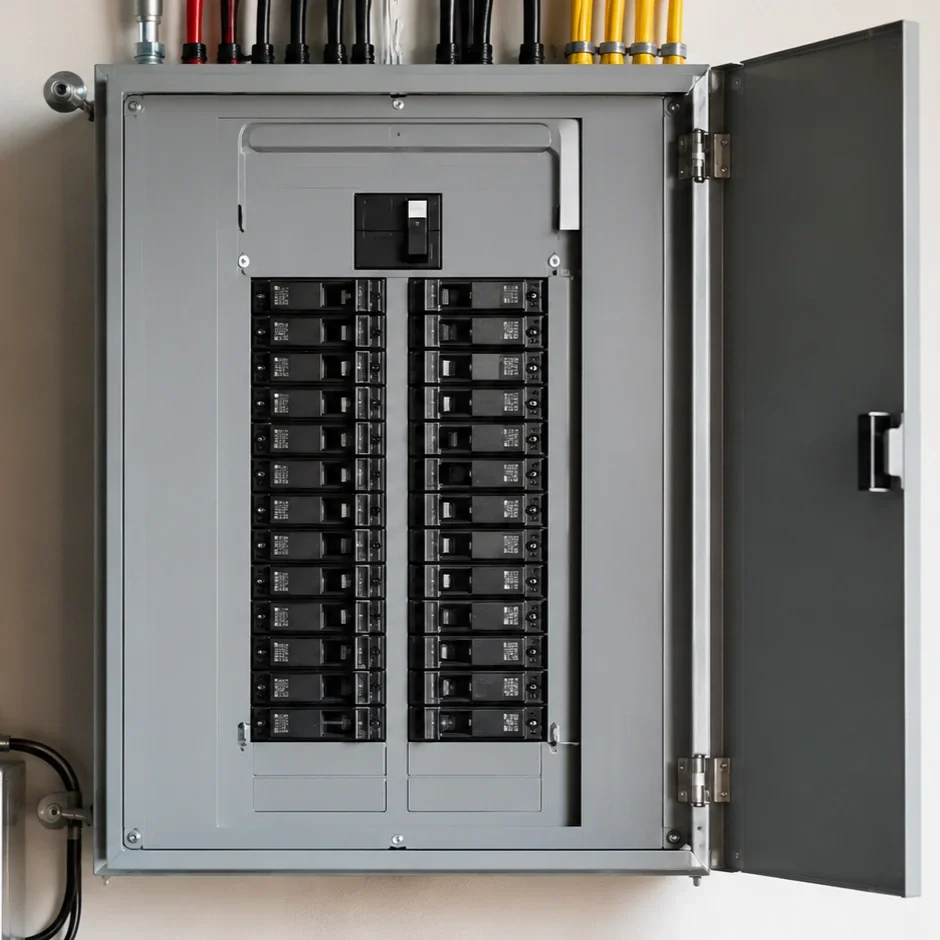
The quote for the new heat pump is sitting on the counter, the EV charger is still in its box in the garage, and you finally pop the cover off the panel to see where the new circuit will go. Every slot is full. Tandem breakers are already doubled up in half the openings, and the main breaker on top reads 100. That single number, more than the age of the house or the brand on the door, determines whether the next big appliance goes in easily or becomes a service upgrade first.
A 100-amp service is not a problem by itself. Plenty of homes run on one for decades without a hiccup. The question is never "is 100 amps bad," it is "does what you actually run, and what you are about to add, still fit inside 100 amps." Once you understand how that number works and how loads stack up against it, the decision to stay put or move to 200 amps is no longer a guess.
What "100 Amps" Actually Measures
Amperage is the rate at which electricity can flow into your home at one moment, not a monthly total you use up. Think of your service like the diameter of a water main. A wider main does not force more water into the house, but it sets the ceiling on how much can flow at once when several fixtures open together. A 100-amp service caps the whole house at 100 amps of simultaneous draw at 240 volts. A 200-amp service doubles that ceiling.
A chain of parts sets the capacity, and the weakest link governs the rating. Power comes off the utility line through the weatherhead and mast, down the service entrance conductors, through the meter, and into the main breaker at the top of your panel. The main breaker is labeled with a rating of 100 or 200. Behind it, two vertical busbars run down the panel, and every branch breaker clips onto them. The service conductors and busbars must be sized to the rating, which is why a real upgrade is rarely just a bigger breaker. A 100-amp service typically feeds through conductors around #4 copper or #2 aluminum; a 200-amp service needs heavier wire, commonly 2/0 copper or 4/0 aluminum, plus a panel with a busbar rated for 200 amps.
So when someone asks whether they can "just swap the main breaker to 200," the honest answer is no. The breaker only protects the wire behind it. Put a 200-amp breaker on conductors and a busbar sized for 100, and you have removed the protection those parts depend on.
How Household Loads Stack Up Against the Ceiling
The reason 100 amps felt roomy for so long is that older homes ran lighter loads: lights, a gas range, a gas dryer, a modest air conditioner, and a handful of small appliances. Electrify those, and the picture changes fast. Electric heating and cooling, cooking, and vehicle charging are the heavy hitters because they run at 240 volts and draw significant current for extended periods.
A rough sense of what the big dedicated circuits draw helps you see how quickly a 100-amp ceiling fills:
| Appliance or load | Typical circuit | Why it adds up |
|---|---|---|
| Central AC or heat pump | 30 to 60 amps | Runs for hours during peak heating or cooling |
| EV charger (Level 2) | 40 to 60 amp breaker | A continuous load; often the single biggest new draw |
| Electric range or oven | 40 to 50 amps | Short bursts, but a large one when in use |
| Electric water heater | 30 amps | Cycles through the day |
| Electric dryer | 30 amps | Long cycles under load |
| Electric furnace or heat strips | 40 to 60 amps | Backup heat can double a heat pump's draw |
You never run all of these at full tilt at the same instant, which is why a house does not trip its main the moment two big appliances kick on. Electricians size a service using a load calculation, which adds your fixed 240-volt appliances to a portion of the general lighting and receptacle load, then applies allowances for the fact that everything rarely peaks together. Continuous loads, such as an EV charger, are counted at 125 percent of their rating because they run for hours rather than minutes. When that calculation climbs past what 100 amps can safely carry, the service is the bottleneck, and no amount of rearranging breakers fixes it.
A hot garage or attic raises the stakes here. Wire carries less current safely as the air around it gets hotter, so a feeder that is fine in a mild space can approach its limit in one that bakes for months. That makes correct sizing and tight connections matter more when a service already runs near capacity.
The Slot Problem: A Full Panel With Nowhere to Land a Breaker
Capacity is one wall you can hit. The other is purely physical: you are out of space. A panel has a fixed number of breaker positions on its busbars, typically 20 to 40, depending on the model. Every new dedicated circuit needs its own position, and once they are all occupied, there is nowhere to clip the next breaker.
Tandem breakers, which fit two narrow circuits into the footprint of a single slot, seem like an easy way out. Sometimes they are. But they only work in positions the panel is specifically rated and labeled to accept, and they only handle 120-volt circuits, not the 240-volt double-pole breakers a range, dryer, or EV charger requires. Cramming tandems where the panel was not designed for them overloads the busbar in that zone, which is exactly the hazard the labeling exists to prevent.
A full panel with real spare capacity is a different problem from a full one that is also near its load ceiling. If the calculation shows headroom but you are out of slots, a subpanel fed from the main adds positions without touching the service. If the service itself is maxed out, more slots do not help, since the new circuits would push the total draw past what 100 amps can carry. Reading which of the two you have is the heart of the decision.
A Framework for Deciding: Stay at 100 or Move to 200
Match your situation to the table below. The left side leans toward leaving a healthy 100-amp service alone; the right side points toward planning a 200-amp upgrade.
| Situation | 100-amp may be fine | Points to a 200-amp upgrade |
|---|---|---|
| Heating and cooking fuel | Gas heat, gas range, gas dryer | Converting to a heat pump, electric range, or electric dryer |
| EV charging | No EV, or Level 1 charging on a standard outlet | Adding Level 2 charging, or a second EV later |
| Panel space | Open slots remain for a circuit or two | Every position is full, tandems already maxed |
| Symptoms under load | Breakers hold during summer peak | Main or branch breakers trip when big loads overlap |
| Solar or battery plans | None planned | Adding solar or a battery that backfeeds the busbar |
| Panel condition | Modern panel, tight connections | Aging panel, corroded lugs, or a known problem-brand panel |
| Load calculation result | Comfortably under the 100-amp ceiling | Calculation lands near or over the limit |
One row deserves its own note. Nuisance tripping under heavy summer or winter demand, where breakers hold most of the year but let go when the air conditioning, oven, and dryer overlap, is a classic sign that the service is running close to its ceiling during peak months, even though it looks fine the rest of the year. That pattern is worth a load calculation before you add anything else.
Age belongs on the list, too, but for a different reason than capacity. A panel a few decades old may still be a fine 100-amp service, yet certain older panels have a track record of breakers that fail to trip when they should. Federal Pacific Stab-Lok and Zinsco panels are the two most cited. If you have one of those, the reason to replace it is safety, and stepping up to 200 amps while the panel is open often makes sense, so you are not back in the same spot in a few years.
When You Can Add the Load Without Upgrading the Service
An upgrade is not the only tool. If a load calculation shows your service is close but not over, a load-management device can let you add a big new circuit without moving to 200 amps. These controllers, sometimes built into an EV charger and sometimes wired as a separate panel accessory, monitor total current and throttle or pause the vehicle charger when the rest of the house is drawing heavily, then resume when demand drops. For a single EV on an otherwise healthy 100-amp home, that is often a cleaner fix than a full service upgrade.
The limits are real, though. A management device buys room for one flexible load, usually car charging, that can wait. It does nothing for loads that must run on demand, like a heat pump on the hottest afternoon or an electric range at dinner. If you are electrifying several major systems at once, the math almost always lands on a 200-amp service, and trying to juggle it all behind a 100-amp main means living with compromises. An electrician running the load calculation can tell you which camp your project falls in before you commit either way.
What Moving to 200 Amps Actually Involves
A service upgrade replaces the whole capacity chain, not just the box on the wall. In a typical job, the electrician coordinates with the utility to disconnect power, then replaces the meter enclosure, the service entrance conductors, often the mast and weatherhead, and the panel with its 200-amp main. New branch breakers land on a busbar with open positions, which finally solves the slot problem. The work is permitted and inspected, and the utility reconnects once it passes. Power is off for part of a day.
The payoff is not a lower bill or more electricity than you use. It is headroom: room to add the heat pump, the charger, the range, or the shop circuit without stacking loads against a ceiling set for a lighter era. Sizing that headroom to what you will add over the next several years, not just today's list, keeps you from paying for the same disruption twice.
Frequently Asked Questions
A subpanel only helps if your service has spare capacity and you have simply run out of physical slots. It taps off the main panel through a feeder breaker and gives you more breaker positions in another location, such as a garage or addition. It does not raise the 100-amp ceiling, since everything on the subpanel still counts against the main. If a load calculation shows the service itself is near its limit, a subpanel makes the crowding worse rather than better.
Often, and the reason is the busbar, not the main breaker. When a solar inverter or battery backfeeds the panel, that backfed breaker plus the main together can only add up to a limited amount relative to the busbar rating, a constraint installers call the 120 percent rule. Many 100-amp panels lack the busbar margin to accommodate meaningful backfeed, so the interconnection requires a line-side tap, a supply-side connection, or a larger service. An electrician checks the panel's busbar rating before designing the tie-in.
No. Amperage is a capacity ceiling, not a measure of how much energy you consume. Your bill tracks kilowatt-hours used, and a wider service does not change how much a refrigerator or air conditioner draws to do its job. What an upgrade can do indirectly is let you run efficient equipment, like a heat pump or an EV, that a 100-amp service could not accommodate, but the panel itself is not an efficiency device.
Read the main breaker at the top of the panel; the number stamped on its handle (100, 150, 200) is your service rating. If the main is not clearly marked, the size of the service entrance conductors and the meter can confirm it, which is something an electrician verifies rather than guessing. Do not assume the largest breaker in the panel is the main; a 60-amp breaker feeding a subpanel is not your service size.
Only where the panel's own label says so. The legend printed inside the door marks which numbered positions accept tandems, and many panels enforce that with CTL (circuit-total-limiting) rejection tabs on the bus that physically block a tandem from seating in a non-rated slot. It also helps to separate a true tandem, two 120-volt circuits sharing one slot, from a "quad" that carries a 240-volt pair on its inner poles only in specific rated positions. Even where they are allowed, tandems cannot serve a standard 240-volt load, so they do nothing for a range, dryer, water heater, or EV charger that needs a double-pole breaker.
Not on its own. A well-maintained 100-amp service that carries the home's loads is a normal, functional setup, and many homes trade hands with one. Where it can matter is for buyers planning to electrify: someone intending to add an EV charger and a heat pump may factor in a future upgrade. The condition and brand of the panel usually weigh more than the amperage number, since a safe, modern 100-amp panel reads very differently from an aging problem-brand one.
Sizing the Panel to What Comes Next
Staying at 100 amps or moving to 200 is really two questions wearing one label: do you have the capacity, and do you have the space? A load calculation answers the first, and popping the cover to count open slots answers the second. When both still have room, adding a circuit is simple. When the service is near its ceiling, additional slots will not save you, and a load-management device can only stretch a single flexible load so far. The clean way through is to size the service to the next several years of loads you actually intend to add, then do the work once.
Planning an EV charger, heat pump, or a panel that is out of room — get a load calculation and an honest read on whether 100 amps still fits. Efficient Electric serves Phoenix, Peoria, and the surrounding West Valley. Call (623) 810-9905.