
Level 1 vs. Level 2 EV Charging: Which Fits Your Drive
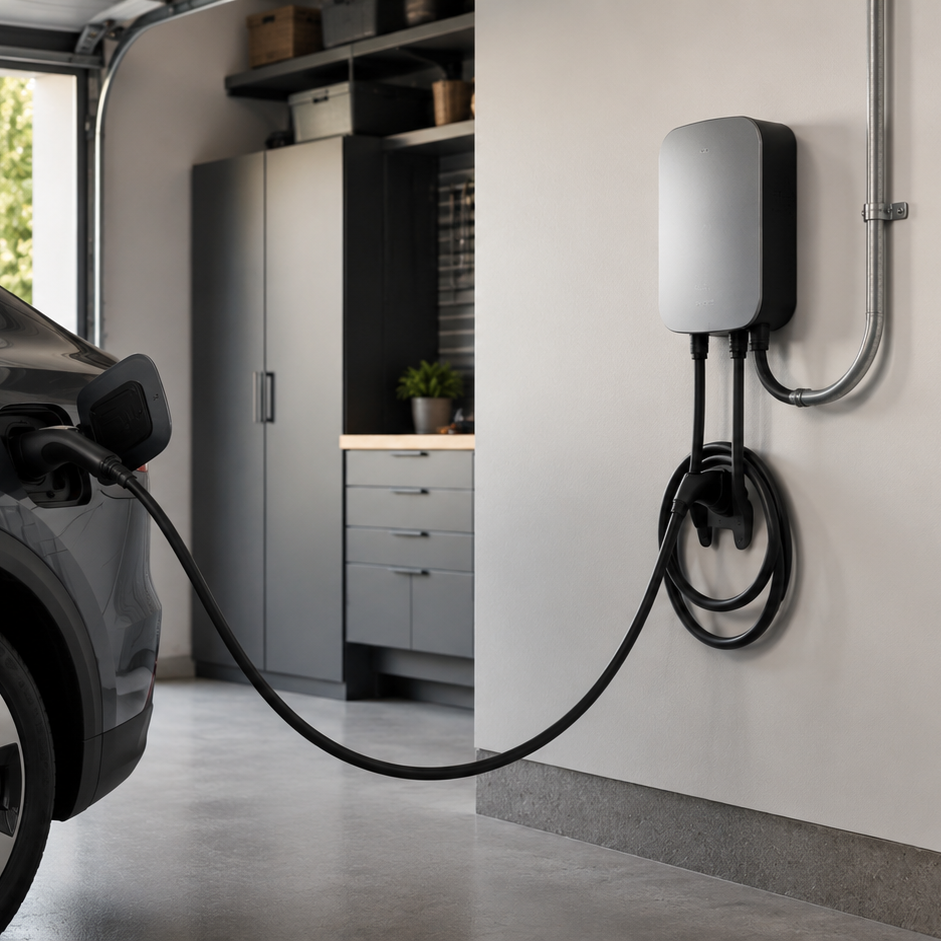
The car is in the driveway, the novelty of the test drive has worn off, and the first real question of ownership has nothing to do with driving: how do you keep it filled up at home? Every new EV ships with a cord that plugs into an ordinary wall outlet, so the honest answer is that you can start charging tonight with hardware you already own. Whether that is enough, or whether you want a faster setup on its own circuit, comes down to a single number you can work out yourself: how many miles you actually put on the car in a normal day.
Home charging comes in two flavors, Level 1 and Level 2, and the whole decision lives in the gap between them. One reuses the outlets already in your garage. The other is a dedicated 240-volt circuit an electrician installs, the same class of supply that feeds your dryer or range. Here is the shape of the difference before the detail.
| Feature | Level 1 | Level 2 |
|---|---|---|
| Voltage and current | 120 volts, about 12 amps | 240 volts, commonly 16 to 48 amps |
| Range added per hour | Roughly 3 to 5 miles | Roughly 20 to 40 miles |
| Circuit and outlet | Standard grounded wall outlet, no new wiring | Dedicated 240V circuit, plug-in or hardwired |
| Equipment | Cord that came with the car | A wall charger (EVSE) plus the circuit |
| Best for | Low daily miles, plug-in hybrids, a long overnight window | Longer commutes, big-battery EVs, two-car homes |
What Level 1 and Level 2 Actually Are
Level 1 is nothing more than the cord in your trunk plugged into a regular 120-volt outlet, the same one your phone charger uses. It draws about 12 amps, which works out to somewhere near 1.4 to 1.9 kilowatts of power. That trickle puts back roughly three to five miles of range for every hour it runs. Nothing gets installed, nothing gets inspected, and the only requirement is a grounded outlet the car cord can reach.
Level 2 doubles the voltage to 240 and opens the tap much wider. Running at 240 volts, a home unit commonly pulls anywhere from 16 to 48 amps depending on how it is set up, which lands in the range of 4 to 11 kilowatts. That returns something like 20 to 40 miles of range per hour, so the same battery that took all night and then some on Level 1 is topped off in a few hours. The tradeoff is that Level 2 needs a real circuit run to it and a wall unit mounted, which is where an electrician comes in.
Think of it as the difference between filling a tub through the bathroom faucet and filling it through a garden hose. Same water, very different flow rate, and which one you need depends entirely on how fast the tub is draining.
Why the Car, Not the Wall Unit, Sets the Ceiling
Here is the piece that surprises new owners and quietly settles a lot of purchase decisions. The wall charger does not actually charge the battery. It hands 240-volt AC power to the car, and a component inside the vehicle called the onboard charger converts that AC into the DC the battery stores. The battery can only be filled as fast as that onboard charger can convert, and the automaker fixes its maximum acceptance rate.
So if your car has a 7.7-kilowatt onboard charger, roughly 32 amps at 240 volts, it will accept 7.7 kilowatts and no more, even if you bolt an 11.5-kilowatt, 48-amp unit to the garage wall. The extra capacity of the wall unit simply goes unused. Two neighbors can own the identical charger and charge at different speeds because their cars accept power at different rates. Before paying for a high-amperage unit, it is worth reading your car's spec sheet for the onboard charger rating, since that number, not the wall box, is often the real limit.
This is only true of home charging. The high-speed stations you see along the highway are DC fast chargers that skip the onboard charger entirely and feed the battery directly, which is why they are so much quicker and also why you cannot install one in a home garage. Both Level 1 and Level 2 at home work through the onboard charger, so both are gentle by comparison.
Who Level 1 Is Actually Enough For
Do the arithmetic on your own driving before assuming you need anything more. A car parked overnight for ten to twelve hours on Level 1 gains somewhere around 30 to 60 miles in that window. If your daily driving, the commute plus the usual errands, stays comfortably under that, Level 1 quietly keeps up, and you never think about it. Plenty of one-car households with a short commute run for years on the included cord and never install anything.
Plug-in hybrids are the clearest Level 1 fit of all. Their batteries are small, often in the 10-to-18-kilowatt-hour range, so an overnight trickle fully refills them with room to spare. Since most plug-in hybrids also have modestly sized onboard chargers, a big Level 2 unit would not fill them much faster anyway. For that kind of car, Level 1 is frequently the right answer rather than a compromise.
Who Should Step Up to Level 2
Level 2 earns its keep the moment your daily miles start to approach or pass what an overnight trickle can replace. A long round-trip commute, a full battery-electric car with a 60-kilowatt-hour pack or larger, or a household charging two vehicles on the same nights all push past what Level 1 can supply. If you have ever done the mental math on whether the car will make tomorrow's drive, that hesitation is the signal.
There is also a buffer argument. Level 2 refills a nearly empty battery overnight, so a spontaneous long trip during the day does not leave you stranded the next morning. In colder weather the case gets stronger, because a portion of the car's energy goes to heating the cabin and the battery rather than to miles, and Level 1's slim margin erodes fastest exactly when you can least afford it. For drivers who want the car full every single morning regardless of yesterday, Level 2 is the setup that delivers it.
What Building a Level 2 Circuit Involves
A Level 2 charger runs on a dedicated 240-volt circuit, meaning a pair of wires and their own breaker serving nothing but the charger. There are two ways to connect the unit, and the choice affects how much current you can pull.
A plug-in charger lands on a NEMA 14-50 receptacle, the same four-slot 240-volt outlet pattern used for many electric ranges. Its appeal is flexibility: you can unplug the unit and take it with you or swap it out. Most plug-in chargers on a 14-50 top out around 32 to 40 amps. Hardwiring the charger directly to the circuit, with no plug at all, is what lets a unit reach the higher 48-amp range for faster charging, and it makes for a cleaner permanent install, especially outdoors.
The current a circuit can safely feed a charger is where the 80 percent rule comes in, and it is simpler than it sounds. Because a charger draws steadily for hours without pause, it counts as a continuous load, and a continuous load is sized to use no more than 80 percent of its circuit's rating. So a 40-amp breaker safely carries 32 amps of charging, a 50-amp breaker carries 40, and a 60-amp breaker is what you need to run a charger at its full 48 amps. That is why a unit advertised as a "40-amp charger" calls for a 50-amp circuit, not a 40. The wire is sized to match the breaker, with 6-gauge copper being typical for a 50-amp circuit, heavy enough to carry the current through a long session without heating up.
Both levels ultimately draw from your main panel, and whether it has a free slot and enough spare capacity for a new 240-volt circuit is a separate question worth confirming before the install, not the one this comparison is here to settle. One detail does deserve a mention: a 14-50 receptacle carrying 32 to 40 amps for hours is a hard-working connection, and a garage that bakes in the afternoon adds heat on top of that, so a quality receptacle rated for EV duty is not the place to cut corners. That holds true year-round, not only in the hottest stretch, since the connection carries the same load every night it charges.
Matching the Level to the Miles
The cleanest way to decide is to let the car tell you. Drive on Level 1 for a week with the included cord and watch where the battery sits each morning. If it holds where you want it, you are already done and can skip the install entirely. If you keep waking up a little short, or you are white-knuckling the range on busier days, that is Level 2 asking to be installed. Many owners take exactly this path, starting on Level 1 the day they get the car and adding a Level 2 circuit only once real-world use proves they need one. Neither level is the "right" one in the abstract. The right one is whichever keeps your specific car ahead of your specific driving without you having to think about it.
Frequently Asked Questions
Not in any way you would notice. Both levels feed the battery through the car's onboard charger at modest rates, and modern battery management treats them almost identically. The charging that stresses a pack over the long run is repeated DC fast charging at the roadside stations, along with routinely filling to a full 100 percent or charging hard in high heat. Many owners set a daily charge limit around 80 percent in the car's settings regardless of which level they use at home, and that habit matters far more to battery life than the choice between Level 1 and Level 2.
No, and it is a genuine fire risk rather than a technicality. The car cord is meant to plug straight into a dedicated grounded wall outlet. A charger pulling 12 amps continuously for eight to twelve hours will overheat a standard extension cord or a power strip, both of which are built for intermittent use, and the connection points are a known place for melting to start. If the nearest outlet is too far away or is shared with other loads, the fix is having an electrician add a proper outlet at the parking spot, not reaching for a longer cord.
Even when the car and circuit are matched, the number on the dashboard rarely holds steady at the unit's rated figure, and three things beyond the equipment explain the gap. First, the rate tapers as the battery fills: past roughly 80 percent the car deliberately eases off to protect the cells, so the final stretch to full crawls compared with the middle of the session. Second, cold weather slows things at the start, because a chilly pack spends power warming and preconditioning itself before it will accept full current, and the live rate climbs only once the battery reaches temperature. Third, a shared or derated circuit can force a lower amp setting: if the breaker, the wiring, or a load-management feature caps the current below the charger's badge rating, the car quietly obeys that lower ceiling. None of these mean anything is wrong; they are the ordinary reasons the displayed rate sits under the sticker.
Yes. In North America, most non-Tesla EVs use the same J1772 connector for both Level 1 and Level 2 AC charging, and Tesla vehicles use the NACS connector, with the industry now shifting toward NACS across brands. The charging level is defined by the voltage and circuit behind the unit, not by the plug at the car, so a single Level 2 charger with the correct connector, or a J1772-to-NACS adapter, serves your car at either level. The connector question and the level question are two separate things people often blur together.
Usually not, though there are exceptions. A plug-in hybrid's battery is small enough that Level 1 typically refills it completely overnight, and its onboard charger is often limited to around 3.3 to 3.7 kilowatts, so a powerful Level 2 unit cannot push power in any faster. The case for Level 2 on a plug-in hybrid appears only when you routinely deplete the battery twice in a day and park for a short window between trips, where cutting the recharge time from several hours to about one actually buys you more electric miles.
Plan on roughly 30 to 60 miles for a ten-to-twelve-hour overnight charge, using the three-to-five-miles-per-hour rate. The honest caveat is cold weather: when the car spends energy warming the cabin and battery, and when that overhead consumes a slice of Level 1's slow trickle before it ever reaches the pack, real overnight gains can fall noticeably below that range. If your daily miles sit well inside the number even on a cold, busy day, Level 1 keeps up. If they crowd it, you will slowly lose ground across a week and feel the pull toward Level 2.
Not sure whether your home needs a Level 2 circuit or Level 1 will do the job — have an electrician look at your outlet, your driving habits, and your available capacity. Efficient Electric serves Phoenix, Peoria, and the surrounding West Valley. Call (623) 810-9905.