
7 Warning Signs Your Electrical Panel Is Overloaded
The air conditioning has been grinding away all afternoon, someone starts the microwave while the dryer is tumbling, and the breaker in the garage clicks off. Half the house goes quiet. You walk out, flip it back on, and it holds until the next time those same things happen to overlap. Nothing is smoking, nothing smells wrong, so it is easy to write off as a fluke and keep resetting it. The panel is actually telling you something specific: at that moment, more current was trying to move than the wiring was built to carry.
An overloaded panel rarely fails all at once. It sends warnings first, and most of them are quiet enough to ignore for months. Knowing how to read those signs, and understanding the difference between one busy circuit and a whole service running near its ceiling, is what separates a quick fix from a slow-cooking hazard.
Before the detail, here is the fast version. If you recognize any of these, the panel is asking for attention.
| Warning sign | What it usually means | What to do |
|---|---|---|
| A breaker trips repeatedly, mostly when big appliances overlap | That circuit, or the whole service, is being asked for more current than it can carry | Note what was running when it tripped; stop resetting and get it read |
| The panel cover or a breaker feels warm to the touch | Sustained high load or a loose, resistive connection generating heat | Do not open it yourself; have an electrician check load and connections |
| Lights dim or flicker when the AC or a motor starts | A momentary voltage sag from heavy startup draw on a strained service | Track whether it is one room or the whole house, then have it evaluated |
| Buzzing, humming, or crackling from the panel | A breaker or lug arcing or vibrating under load | Treat as urgent; keep clear and call an electrician |
| A burning smell, or breakers that look scorched or discolored | Heat has already damaged insulation or contacts | Cut power to that circuit if you safely can and call right away |
| Power strips and extension cords running the essentials | Too few circuits for how you actually live | Add dedicated circuits rather than splitting the ones you have |
| A panel packed with tandem breakers and no open slots | The panel has run out of room and may be past its design | Have capacity assessed before adding anything else |
What "Overloaded" Actually Means
Two different problems hide under the word overloaded, and telling them apart is the whole game.
The first is a single branch circuit overload. Every outlet and light in your home sits on a circuit protected by one breaker, usually rated 15 or 20 amps for the general 120-volt circuits. Plug a space heater, a microwave, and a hair dryer into outlets that all trace back to the same 15-amp breaker, and their combined draw sails past that limit. The breaker does exactly its job and trips, cutting power before the wire behind the wall can overheat. That is a local problem: too much on one circuit, often solved by spreading things out or adding a dedicated circuit.
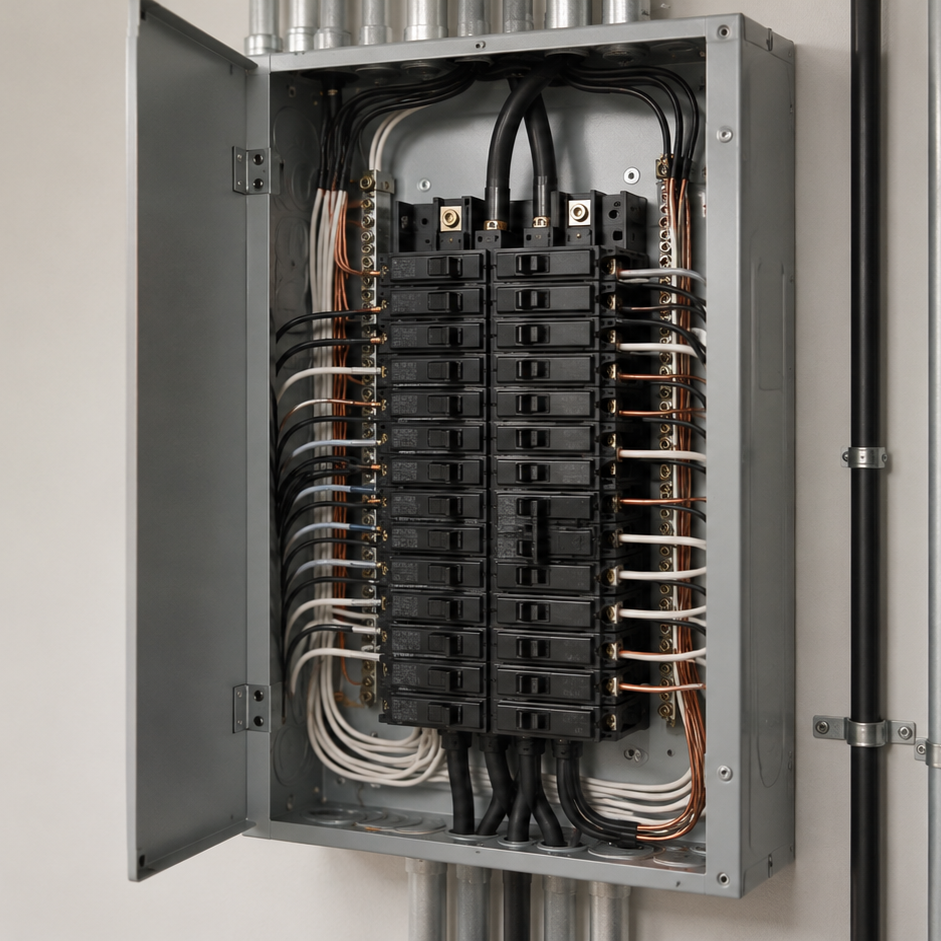
The second is a service or panel-level overload. Your whole home is fed through a main breaker, rated 100, 150, or 200 amps, and every branch breaker clips onto two vertical busbars behind it. The main sets the ceiling on how much current the entire house can pull at one instant. You never run everything at once, so the total live draw, what electricians call the demand, normally sits well under that number. When enough heavy loads overlap and the demand climbs toward the main's rating, you start seeing whole-house symptoms: the main itself trips, the panel warms, and lights sag across the house rather than in one room.
Amperage is a rate, not a monthly quantity. Picture the service as the diameter of a pipe feeding the house. It does not push more water in, but it caps how much can flow the moment several taps open together. A circuit overload is one faucet wide open past its own limit. A service overload is every faucet running while the main pipe struggles to supply them. Both trip breakers, but the fix is not the same, which is why the first thing a good electrician does is figure out which one you have.
Frequent Tripping Is the Headline, Not the Whole Story
A breaker that trips now and then, resets, and holds is doing precisely what it was designed to do. The warning is in the pattern. If the same breaker lets go every time the same two or three appliances run together, that circuit is chronically overloaded, and repeatedly resetting it just asks the breaker to save you over and over. If your main breaker is the one dropping, or several circuits trip during the same heavy stretch, the service as a whole is the bottleneck.
There is a useful tell in how the breaker behaves. An overload trip usually takes a little time, since the breaker has a thermal element that heats up and releases after current stays high for a stretch. A breaker that snaps off instantly the moment you reset it is usually reacting to a short circuit or a ground fault, a different fault entirely, not a matter of too much load. Knowing which you are seeing points the electrician in the right direction before they ever open the cover.
Warmth, Smell, and Sound: The Panel Talking Through Your Senses
Electricity turns into heat wherever it meets resistance, and that heat is one of the earliest honest signs of trouble. A panel cover that feels warm, or an individual breaker noticeably hotter than its neighbors, points to either a sustained heavy load or a loose connection acting like a tiny heater. In the summer, when air conditioning keeps a service near its working limit for months, a marginal panel or a loosening lug tends to show up as heat first, though the same weak connection exists in the mild season when the house barely draws anything.
Sound and smell escalate the urgency. A faint hum from a panel is normal; a loud buzzing, crackling, or sizzling is not. That noise is often arcing at a loose terminal or a breaker no longer seating tightly on the bus, and arcing is how heat becomes damage. A sharp, plasticky burning smell, or breakers and bus stabs that look browned, melted, or discolored, means heat has already cooked insulation or contacts. At that point the question is no longer whether the panel is overloaded but how much damage has been done. Keep clear of it, cut power to the affected area if you can do so safely from a different switch, and get an electrician out rather than probing inside the box yourself.
Dimming and Flickering When the Big Loads Kick On
Watch your lights the next time the central air compressor or a large motor starts. A slight, brief dip is ordinary; motors draw several times their running current for a fraction of a second as they spin up, and that momentary voltage sag shows as a quick flicker. What matters is the degree and the spread. A deep, obvious dim across the whole house every time a big appliance cycles suggests the service is straining to deliver the surge, or that a connection between the utility and your panel has loosened and is choking the flow.
Localized flicker in one room usually means a loose connection on that circuit or an overloaded string of outlets. House-wide dimming that comes and goes points upstream, toward the panel, the main connections, or the service itself. Either way, lights that used to hold steady and now sag are reporting that the electrical path is working harder than it should to keep voltage up.
Too Few Circuits: Power Strips and a Packed Panel
Some overload signs are about how the system is set up rather than a fault inside it. If your daily life runs on power strips and extension cords, and if the same wall outlet feeds a surge strip that feeds three more things, the house does not have enough circuits for how you use it. A power strip does not add capacity; it splits one circuit's limit among more plugs, which is exactly how a single 15-amp circuit ends up carrying a room's worth of electronics.
The panel itself tells a similar story. Open the cover and count: if every position is occupied and half of them hold tandem breakers, the thin double breakers that fit two 120-volt circuits into one slot, someone has already been fighting a space problem. Tandems are legitimate only in the specific positions a panel is labeled to accept them, and they cannot serve the 240-volt loads a range, dryer, or car charger needs. A panel jammed full of them, with no open slots left, is a sign the service was sized for a lighter era than the one you live in now. Sometimes the answer is redistributing circuits or adding a subpanel for room, and sometimes the service itself is undersized, and an upgrade is the honest fix, but that call starts with correctly reading which kind of overload you are dealing with.
Reading the Signs Together
No single symptom convicts a panel on its own. A breaker trips for many reasons, and lights flicker for a loose bulb as readily as a strained service. The picture forms when the signs cluster: trips that track with heavy use, warmth at the box, dimming when the compressor starts, and a panel with no room left all pointing the same way. Write down what runs when the trouble shows up, resist the urge to keep resetting or to swap in a bigger breaker, and let someone measure the actual demand. A clamp meter on the main conductors and a load calculation turn a hunch into a number, and that number tells you whether to spread the load, add circuits, or address the service itself.
Frequently Asked Questions
An occasional trip you can reset and forget is usually the breaker doing its job during a rare pileup of loads, and it is not an emergency. The concern is a pattern: the same breaker letting go under the same conditions week after week, or a breaker that will not reset at all. One that trips again the instant you flip it back on is signaling a short circuit or ground fault rather than an overload, and that needs diagnosis, not repeated resetting. A breaker is a safety device with a finite number of trips, so leaning on it as a routine switch wears it out.
No, and this is one of the more dangerous shortcuts. A breaker is matched to the wire behind it, not to your appliances. A 15-amp breaker protects 14-gauge wire; a 20-amp breaker protects 12-gauge. Fit a 20- or 30-amp breaker onto a circuit wired with 14-gauge, and the breaker will now let the wire carry far more current than its insulation can handle before it ever trips, which is how wires overheat inside walls. The right move is to reduce what is on the circuit or add a properly wired new one, never to raise the breaker to silence the symptom.
Heat without much load usually points to a connection rather than demand. A lug that was never torqued to spec, a breaker not fully seated on the bus, or an oxidized connection, common where aluminum conductors are involved, all add resistance, and resistance turns current into heat at that exact spot. That is why a panel can run warm even on a light load, and why a warm breaker often signals a loose terminal rather than an overload. An electrician can check connections with a torque driver and often spot the hot joint with a thermal camera.
They add plugs, not capacity, and the distinction matters. Everything on a power strip still draws through the single circuit that one wall outlet belongs to, so five things on a strip can overload a 15-amp circuit as easily as five things in five outlets on it. Daisy-chaining one strip into another concentrates even more load on that lone circuit, which is why manufacturers warn against it. A surge protector guards electronics against voltage spikes from storms or grid switching; it does nothing to relieve an overloaded circuit. Real relief comes from a dedicated circuit run back to the panel.
They measure rather than guess. Clamping a meter around the main service conductors shows the total current the house is pulling in real time, and doing that while big appliances run reveals how close the demand gets to the main breaker's rating. A load calculation adds up your fixed 240-volt appliances plus a portion of the general lighting and receptacle load to estimate peak demand against the service size. If the total sits comfortably under the ceiling but one breaker keeps tripping, the problem is that circuit. If the demand crowds the main during normal heavy use, the service itself is the limit.
Yes, and one alternative is serious enough to rule out quickly. If lights dim in some rooms while brightening or buzzing in others, especially at the same time, that can indicate a loose or failing neutral connection at the panel or out at the utility service, not a simple overload. An open neutral lets voltage swing unevenly across the two legs of your service and can push too much voltage to some circuits, damaging electronics. That symptom warrants an electrician promptly, and sometimes a call to the utility, because part of that connection sits on their side of the meter.
Book a panel evaluation and load reading before the tripping turns into damage — get an honest read on whether you have a circuit problem or a service that is out of room. Efficient Electric serves Phoenix, Peoria, and the surrounding West Valley. Call (623) 810-9905.