
Half Your Outlets or Lights Suddenly Dead? Why It Happens
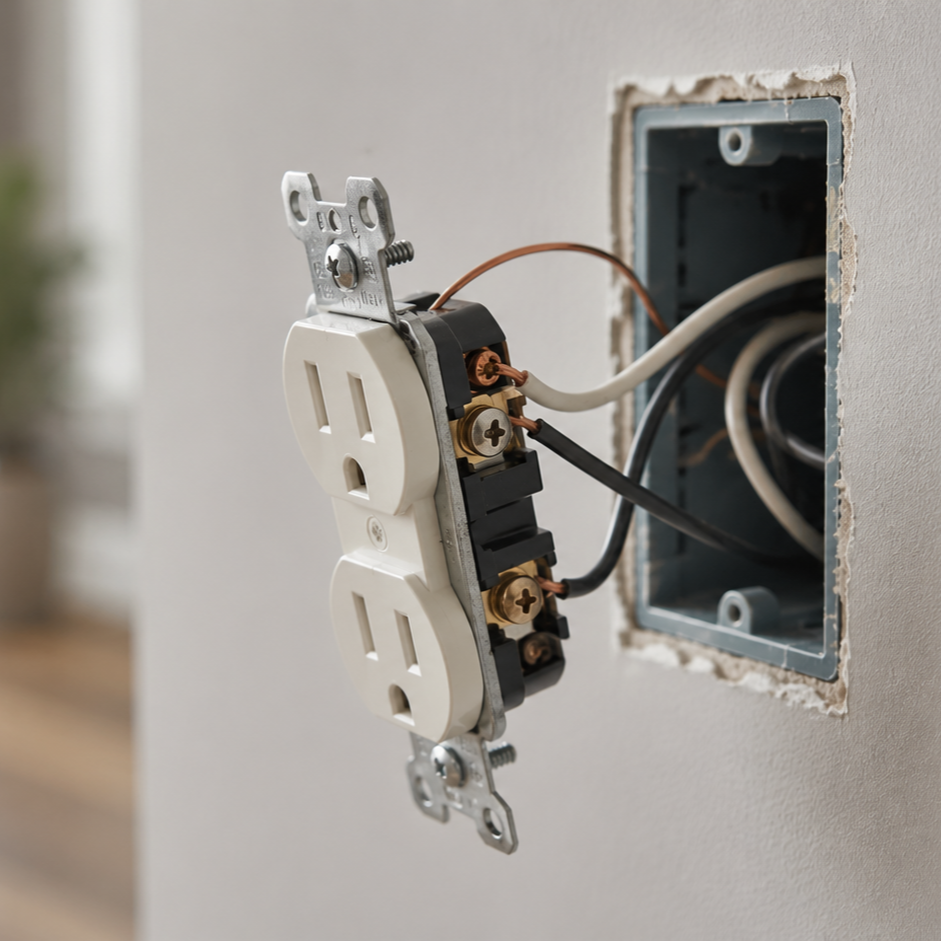
When part of a room goes dead while the rest keeps running, the wiring is pointing at something specific: power has failed at one point on a chain, not across the whole circuit. Outlets are rarely wired straight back to the panel one at a time. They are linked in a run, each handing power to the next, so when a link breaks at one box, everything past it goes dark while everything ahead keeps working. That makes a dead cluster of outlets a location question: where along the run did power stop, and the answer points to a specific fault. A few are a reset you can do in seconds; a couple are the kind you stop and call about.
Work the possibilities from easy toward serious, roughly in this order:
Reset every GFCI in the area: a tripped GFCI kills every plain outlet on its LOAD side, and the one that tripped is often in another room, the garage, or an outdoor box. Press reset on each and watch for the dead outlets to return.
Cycle any breaker that sits off-center: a tripped breaker can stop in a middle position that still looks on. Push the handle firmly to OFF, then back to ON to clear the latch.
Note the last outlet that still works: if resets do not fix it, the break is usually a loose backstab or open splice in the next box down. A warm or discolored faceplate marks it, and that is a stop-using-it sign.
Watch for outlets dead while others glow bright or flicker: that split pattern is an open shared neutral on a multi-wire circuit. Switch off both tied breakers and call an electrician.
Look for a wall switch before assuming a fault: a single receptacle, or half of one, may be a half-hot switched outlet working as designed. Flip any nearby switch that controls nothing.
If roughly half the house is dead at once: suspect a lost service leg at the panel or on the utility's side; a call to an electrician and likely the power company, not a reset.
Why a Whole Section Dies at Once
Wiring a house one outlet at a time back to the panel would waste enormous amounts of cable, so almost no one does it. Instead, power runs into the first box on a circuit, then a cable carries it to the next box, then the next, like ornaments strung along a wire. Electricians call this a daisy chain. Each outlet passes power along to the one after it.
That design is efficient, and it explains the mystery: if the connection breaks at one box, every outlet past that point loses power while everything before keeps working. So the question is never really "why is this outlet dead." It is "where on the chain did the power stop," and the last working outlet is your biggest clue.
Check the Upstream GFCI First
This is the most common cause and the easiest to fix, which is why it goes first. A GFCI outlet has two pairs of screws. The LINE terminals bring power in. The LOAD terminals send protected power onward to other ordinary outlets down the chain. Every outlet fed from those LOAD terminals is covered by that one GFCI, even though those outlets have no reset button of their own.
So when a GFCI trips, it does not just kill itself. It cuts power to every plain outlet wired downstream of it. The catch: the tripped GFCI is often nowhere near the dead outlets. Builders frequently chain a bathroom, the garage, and an outdoor receptacle all onto one GFCI to save on devices, so a bedroom outlet can go dark because a GFCI in the garage or on the patio tripped after a rainstorm. Before anything else, find every GFCI in the house, bathrooms, garage, kitchen, outdoors, and press reset on each. If one clicks and your outlets return, that was it. If it will not hold a reset, there is a real fault on that run worth tracing, not defeating.
The Breaker That Tripped but Looks On
The panel can fool you. When a breaker trips, its handle usually does not snap all the way to OFF. It stops in a middle position, sitting just slightly off from its neighbors. In a row of twenty breakers, that small offset is easy to miss, and the breaker looks like it is still on.
A tripped breaker also will not reset if you only nudge it toward ON, because the internal mechanism has to be cleared first. The fix is to push the handle firmly all the way to OFF, past where it wants to stop, then back to ON. That full off-then-on motion resets the latch inside. If the breaker holds, you are done. If it trips again right away, or refuses to move to ON and stay there, stop. A breaker that trips the instant you reset it is reacting to a short or a ground fault on that circuit, and that needs to be found, not forced.
A Loose Backstab or Wire-Nut Connection
When the easy resets do not solve it, the trouble is usually a connection that has come apart inside a box, and this is where the daisy chain shows its weak point. Many outlets are wired using the backstab holes on the back of the receptacle, where the wire pushes into a spring-loaded slot instead of wrapping around the side screws. It is fast for installers, but a backstab grips the wire with a small metal tab over a tiny contact area. Years of heating and cooling as loads come and go let that grip relax: resistance climbs, the spot heats up, and eventually it stops passing power altogether.
Here is why that kills a whole section: if the failed outlet is being used to feed the next one down the line, everything past it goes dead the moment the connection opens, while that outlet and the ones before it may still work. The same thing happens with a loose wire nut on a splice, or a wire that backed out of a screw. Because these connections run hot before they fail, this is the cause most likely to leave a warm or discolored faceplate, a faint smell of hot plastic, or a scorch mark inside the box. That heat is why a failing backstab is not a wait-and-see problem. If resetting turns up nothing and you find a warm outlet, stop using that circuit and have the connections opened up and redone properly on the screw terminals.
An Open Neutral on a Multi-Wire Circuit
Some circuits are wired as a multi-wire branch circuit, or MWBC. Instead of running two separate cables, an electrician runs one cable with two hot wires on opposite legs of the panel and a single shared neutral serving both. It is a legitimate, space-saving setup common for kitchen counters. The shared neutral normally carries only the small difference between the two sides.
The failure mode does not look like a simple dead outlet. If that shared neutral connection comes loose or opens somewhere, the two circuits are suddenly wired in series across the full 240 volts feeding the panel. Voltage then splits based on whatever is plugged in, so one side gets far too little and goes dead or dim while the other gets far too much. That is the tell: outlets dead on one part of the circuit while lights elsewhere burn unusually bright, buzz, or flicker, and sensitive electronics can be damaged in the process. An open neutral on an MWBC is not a reset. Switch off both breakers feeding it, which are often joined by a handle tie, and get an electrician on it, because that floating neutral can sit at a dangerous voltage even when things look off.
A Half-Hot Outlet That Was Never Broken
Not every dead outlet is a fault. Builders often wire one receptacle in a living room or bedroom as a "half-hot" or switched outlet, so a wall switch by the door can control a lamp plugged into it. To do this, the small metal tab that normally joins the two hot screws on the side of the receptacle is snapped off, splitting the outlet into two halves. The top half might stay live all the time while the bottom half only has power when the wall switch is on.
If a single outlet, or just the top or bottom of one, seems dead, look for a wall switch that does not appear to control any light. Flip it and check the outlet again. Many people discover an outlet was switched only after plugging something important into it and wondering why it keeps losing power. This one is not an emergency and not a repair. It is the wiring working exactly as intended. The only time it becomes a real fault is when the switch itself wears out and fails, which stops the switched half from powering up at all.
A Lost Leg of the Incoming Service
The largest version shows up when it is not one circuit but roughly half the house that goes dead at once. Utility power arrives as two hot legs plus a neutral, and your panel splits the circuits between them. Everything works only if both legs are feeding power. If one leg is lost, every 120-volt circuit tied to that leg goes dark while the circuits on the other leg keep running, which is why it can feel like exactly half the house quit.
A lost leg comes from a failed connection, and it can live on either side of the meter. It might be a corroded or loosened main lug inside your panel, a failing main breaker, or a bad connection out at the utility's drop or transformer. Sometimes 240-volt appliances behave strangely, since they need both legs, and lights on the affected side may dim or surge much like an open neutral. Because part of this connection sits on the utility's equipment, this is a two-call situation: an electrician to check the panel and service connections, and the power company to inspect their side. It is never a breaker you can reset your way out of.
Working From the Panel to the Wall
A section of dead outlets is really a map with an X on it. The free fixes come first: reset every GFCI, then cycle any breaker that looks even slightly out of line. If power does not return, the last working outlet on the run marks roughly where the chain opened, usually a loose connection in the next box down. Once the signs turn to heat, an odd voltage pattern, or half the house out at once, the reset stage is over, and the job is finding a failed connection or a lost leg, which is where a tester and trained hands earn their keep.
Frequently Asked Questions
With the GFCI tripped, walk the house and note every outlet that is dead. Those are all on that device's LOAD side. Then reset the GFCI and confirm they come back together. The surprise for most people is how far a single GFCI reaches: builders often chain every "wet location" receptacle onto one device, so a dead bathroom outlet can trace to a GFCI in a second bathroom, the garage, or an exterior box on the far side of the house. If a bathroom outlet is out, check the garage and patio GFCIs before assuming the fault is local.
It comes down to contact area. A backstab holds the wire with a thin spring tab pressing on one narrow strip of copper, so the electrical contact is small and depends entirely on that spring staying tight. Wrapping the wire around the side screw, or using the clamp plate found on better spec-grade receptacles, presses far more metal together and resists loosening. Repeated heating and cooling from normal loads gradually relaxes a backstab's spring, and the fix a pro uses is to move the wires to the screw terminals or add a short pigtail, so the connection no longer depends on that weak grip.
Yes, which is exactly why MWBCs deserve caution. The neutral is shared with a second circuit that may still be live, so current from that other side can flow on the shared neutral even after you have switched off the breaker in front of you. If the neutral is open, it can also float up to line voltage. That is why both hot legs of an MWBC belong on breakers joined with a handle tie, so they shut off together, and why this is not a circuit to poke at with only one breaker off.
No, and that specific pattern deserves faster attention. Roughly half the house out, lights on the live side surging or dimming, and 240-volt appliances acting strangely point toward a lost service leg or an open main neutral, not a single tripped breaker. A quick check is whether neighbors lost power too, which suggests the utility's side. Because that connection can involve the service drop, the meter base, or the main lugs, it usually takes both an electrician and the utility to sort out, and it is not something to keep resetting.
No. A breaker that trips again the moment you reset it is sensing a real fault, and each reset drives current back into whatever is arcing or shorted, adding heat every time. Breakers also have a limited number of trips in them and wear out from being cycled hard. If a breaker will not hold, or you notice warmth or a hot-plastic smell near the panel or an outlet, stop resetting and have it diagnosed. Repeated resetting into a loose, arcing connection is how a nuisance turns into scorched wiring.
Yes, and it is a common source of confusion. When an outlet feeds the next one on the chain, its own internal path carries power through to the downstream cable. That path, or the terminal feeding the outgoing wire, can fail while the outlet's face still powers a plug through the incoming side. The outlet looks fine and runs a lamp, yet everything past it is dead. This is why electricians often pigtail the connections, joining the wires with a short separate lead to the device, so one failed receptacle cannot break the whole run.
If resetting the GFCIs and breakers does not bring your outlets back, have the circuit traced before a loose connection overheats. Efficient Electric serves Phoenix, Peoria, and the surrounding West Valley. Call (623) 810-9905.