
Scorch Mark or Burning Smell at an Outlet? Shut It Off
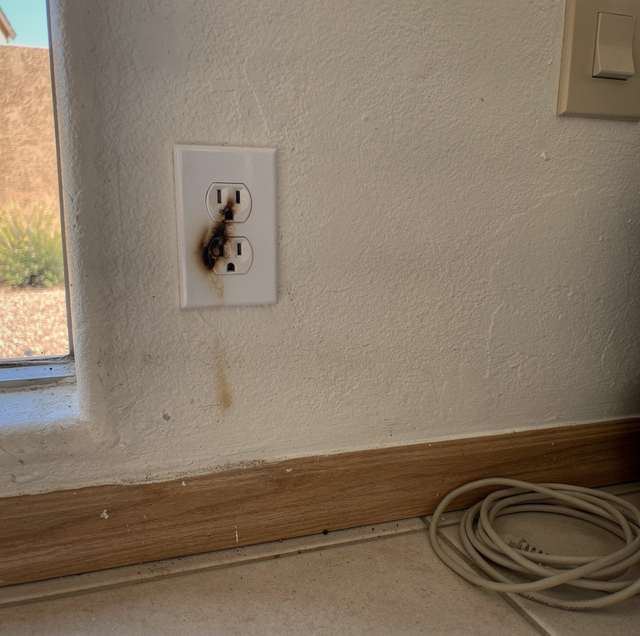
You pull a lamp cord out of the wall and find a tan shadow fanning up from the slot, with a black smudge at its center. Or the hallway smells like hot plastic twenty minutes after you plugged in a hair dryer, and the smell fades once you unplug it. Neither is a hint that something might go wrong later. Both are residue. Something inside that box already ran hot enough to break down plastic, and the mark or the odor is what the event left behind.
If you can see smoke or flames, or the smell is strong and getting stronger, stop reading, get everyone out of the house, and then call 911 from outside. Short of that, the first move is not to work out which appliance did it. Stop using the receptacle, switch off the breaker that supplies it, and have a licensed electrician open it up.
QUICK ANSWER: A scorch mark or burning smell is residue, not a warning. The heat or arcing already happened inside that box, and an untripped breaker proves nothing about severity. Kill the circuit and leave it off until a licensed electrician opens it.
Turn the Circuit Off First, Then Read What Is Left
Unplug whatever is in the outlet and plug nothing else in. Go to the panel, switch off the breaker for that circuit, and leave it off until an electrician has been inside that box. If the panel directory is missing or wrong, and many are, shut off the main rather than guessing, because guessing at a breaker and getting it wrong leaves the fault energized while you believe it is dead.
After that, the mark on the face and the odor in the air are the only record of what happened, and both are worth reading rather than wiping away. You cannot tell from the front whether the damage stopped at the face plastic or reached the conductor insulation, the box, and the framing behind it. What you can do is notice what the evidence looks and smells like, because those details narrow what the electrician is looking for.
WARNING: If the burning smell persists after the breaker is off, leave the house and call 911 from outside. Power gone and odor continuing means something in the wall has caught and is now burning on its own.
The Mark and the Smell Are Both Records of Heat
Two physical events leave this signature, and they often run together. The first is resistive heating at a connection. Every joint has some resistance, and a good screw termination measures in the thousands of ohms, while a loose or oxidized one can sit at a fraction of an ohm. That is far too little to affect anything the circuit runs, and far more than enough to matter, because the power given up at a joint is the current squared times that resistance. Push 12.5 amps through half an ohm and roughly 78 watts is released in a contact patch a few millimeters across, sealed inside a plastic box. Standard building wire is insulated to a 90-degree Celsius rating, about 194 degrees Fahrenheit. A joint doing that walks past the number and keeps climbing.
The second event is arcing. Once a connection is loose enough that contact breaks and remakes as the load cycles, current starts jumping the gap instead of crossing it. An arc is a plasma column running to thousands of degrees, hot enough to erode copper and vaporize the plastic it touches. What it leaves behind is carbon, and carbonized plastic conducts, so the char from one arc gives the next one an easier path.
Both events do their worst work at the back of the device, where the conductors land. Heat reaches the front by conduction through brass and plastic, which takes time, so by the point the face has browned, the terminations behind it have run hot for a long stretch.
A Breaker That Never Tripped Proves Nothing
A standard thermal-magnetic breaker watches one thing: how much current is moving through the wire. A bimetal strip bends as it heats and opens the breaker on a sustained overload, and an electromagnet snaps it open almost instantly on a short circuit drawing hundreds of amps.
Neither mechanism can see heat inside a box. A loose termination on a circuit carrying 9 amps still carries 9 amps, and a series arc restricts current rather than raising it, so the breaker reading goes down, not up. A joint can dissipate enough heat to char the framing behind it while the breaker measures a load it considers entirely normal, and it can do that indefinitely, because the fault never produces the one condition the breaker was built to detect.
This is the part homeowners most often have backwards. A breaker that held is not evidence that the event was minor. It is evidence of nothing at all. An arc-fault circuit interrupter is a device designed to detect the electrical signature of arcing rather than the current magnitude, and many older circuits lack one. A GFCI is looking for current leaking off the circuit to ground, which a hot connection does not do, so it can sit unbothered through the same fault.
What Each Odor Actually Records
Four smells turn up around an overheated outlet, each from a different material. Noticing which one it was, and whether it followed the appliance or stayed at the wall, is useful to whoever opens the box.
Hot thermoset plastic is the sharp, acrid one, often described as fishy or faintly sweet. Older receptacles, switches, and wiring devices are molded from phenolic or urea-based compounds that do not soften and run when they overheat; they char in place. So this odor can be strong while the face still looks almost untouched.
Melting thermoplastic smells softer and oilier, closer to a hot glue gun than to something burning. That is the modern device body and the insulation on the conductors, and unlike phenolic it slumps before it chars. Deformed slots, a glossy sheen on the face, or a plug that will not release cleanly go with this one.
A smoky smell, closer to burning cardboard, is another stage: the heat has left the device and reached organic material, such as older cloth-braid cable, the paper facing on the drywall behind the box, or the framing itself.
The fourth is ozone, sharp and closer to chlorine or hot metal, produced when an arc ionizes the air. It points toward arcing rather than steady heat, and it can appear with no mark at all, since an arc inside a box leaves its carbon inside the box. Separate from all four, an overheating motor winding in the appliance smells of scorched varnish, is strongest at the appliance's own vents, and fades as the appliance cools. That one says look at the load, not the wall.
Reading the Mark, on the Face and on the Plug
The marks separate more cleanly than the smells do, because three mechanisms leave three different shapes. A tan-to-brown halo fanning out from a slot has diffuse edges, no soot, and plastic still hard to the touch. That is heat conducted forward from the terminations behind the face, and it records a long stretch of steady resistive heating rather than a single event.
A black streak, usually running upward from a slot and sometimes reaching toward a mounting screw, is a surface track: dust, humidity, or carbon left by an earlier small arc has given current a path across the face itself. It is shallow, it smears if you rub it, and it is the one that grows on its own, because every pass across it lays down more carbon. Pitting is the third, small craters with bright metal showing at the bottom, found on the brass contact clips inside the device rather than on the face, and it comes from an arc making and breaking at the contact.
Depth separates severity better than area does. Discoloration is only the surface layer of the plastic reacting, while a slumped face, deformed slots, or a device that grips a plug so hard it will not release all mean the body passed its softening point, which sits well above the temperature at which it merely browns. When only one slot is marked, the heat came from that terminal specifically, which narrows where the electrician starts. It does not tell you which conductor: a loose grounded conductor heats exactly as hard as a loose ungrounded one, because the same current crosses both.
The same reading applies to the plug. If the molded plug body is browned while the receptacle face is clean, the higher-resistance joint sat on the appliance's side of that interface. If one blade has gone dark along its length while the other is still bright, the heat was at that one blade's contact.
TIP: Leave the device in the wall. Pulling a scorched receptacle yourself destroys the evidence an electrician reads: which terminal blackened, whether the copper annealed, and how far the char ran into the box.
The Faults the Evidence Points At
Ranked by how often they produce this exact result, five causes cover nearly all of it. Loose terminations come first by a wide margin. Most receptacles accept a conductor in two ways: under a screw or pushed into a hole on the back where a small spring blade bites it. The push-in contact patch is tiny, so a device wired that way is the most common source of a browned face.
Second is a receptacle whose internal brass clips have lost their spring temper, which puts the heat at the face rather than in the box and often shows up first as a plug that sags out under the weight of its own cord. Third is a heavy load held near a general-purpose circuit's limit for hours at a stretch, which holds every marginal joint on that circuit near its limit alongside it. Fourth is aluminum branch-circuit conductors landed on a device not listed to accept them, a known heat source at the termination with its own repair method. Fifth, and hardest to spot, is trouble out of sight: dust and moisture letting current creep across the plastic between terminals in a garage or patio box, or a cable crushed by an overdriven staple behind the device, which produces the odor with nothing at all to see on the face.
What an Electrician Finds Once the Plate Comes Off
The work starts by proving the circuit dead at the conductors with a meter, not a non-contact tester, which often returns false negatives in deep or crowded boxes, so nobody relies on it alone.
Then the device is removed, and the evidence is read at close range. A blackened screw head. A spring blade in a push-in hole that has lost its bite. Copper gone dull and dark where it was heated, which matters because heated copper anneals soft and will not hold a mechanical joint properly again. Insulation shrunk back from the end of a conductor. Char on the inside wall of the box.
What is found decides the scope. If the damage stopped at the device, the repair is the device plus the last inch or two of wire: cut back past every trace of discolored copper to bright metal, re-strip, and land it under a screw terminal at the torque value the manufacturer prints on the device, set with a torque screwdriver rather than by feel. If the box itself has carbonized, it gets replaced, because charred plastic is a conductive path and cannot be cleaned back to good.
Frequently Asked Questions
With the breaker off, nothing on that circuit is live, which is why it's better to switch it off rather than unplug. The part people get wrong is confirming they killed the right one. A room's lighting and its receptacles frequently share a single circuit, so a ceiling light going dark is weak proof, and a lamp plugged into a nearby receptacle on the same wall is the better check.
Odor travels. It moves along a stud bay and vents at the nearest opening, so the strongest smell can sit a floor above the failure, or at a switch box sharing the same cavity, rather than at the device that made it. Every closed box on the circuit holds terminations and has no face for you to inspect: ceiling fixtures, junction boxes above a light, and the panel itself are all candidates.
No, and it is the least reliable thing to judge by. The face plastic browns from heat conducted forward off the terminations, so a device with a faint tan halo can have a worse joint behind it than one with an obvious black streak. A strong odor with a clean face is the same finding, not a milder one.
Usually because that device was carrying more current than its neighbor. Receptacles are commonly wired feed-through, with the circuit landing on one device and continuing to the next from the same screws, so those terminations carry everything downstream as well as whatever is plugged into that face. A receptacle fed by a pigtail carries only its own load, which is why the marked device is often the busiest joint on the run rather than the only weak one, and why the rest of the circuit gets opened too.
Because the fault may be leaving with it. A plug whose blades have pitted or a cord that has gone stiff in the last few inches carries its own high-resistance joint into whatever outlet it meets next, and the outlet takes the blame the second time as well.
Not reliably. A smoke alarm samples room air for combustion particles, and a connection smoldering inside a closed box in a wall cavity may release very little into the room until the fire has already involved the framing. Alarms are the last line here, not the detection method.
Book an electrical diagnosis — get the outlet opened, the circuit checked, and the damage repaired before it goes any further. Efficient Electric serves Phoenix, Peoria, and the surrounding West Valley. Call (623) 810-9905.