
Never Backfeed a Generator Into an Outlet: The Deadly Reason
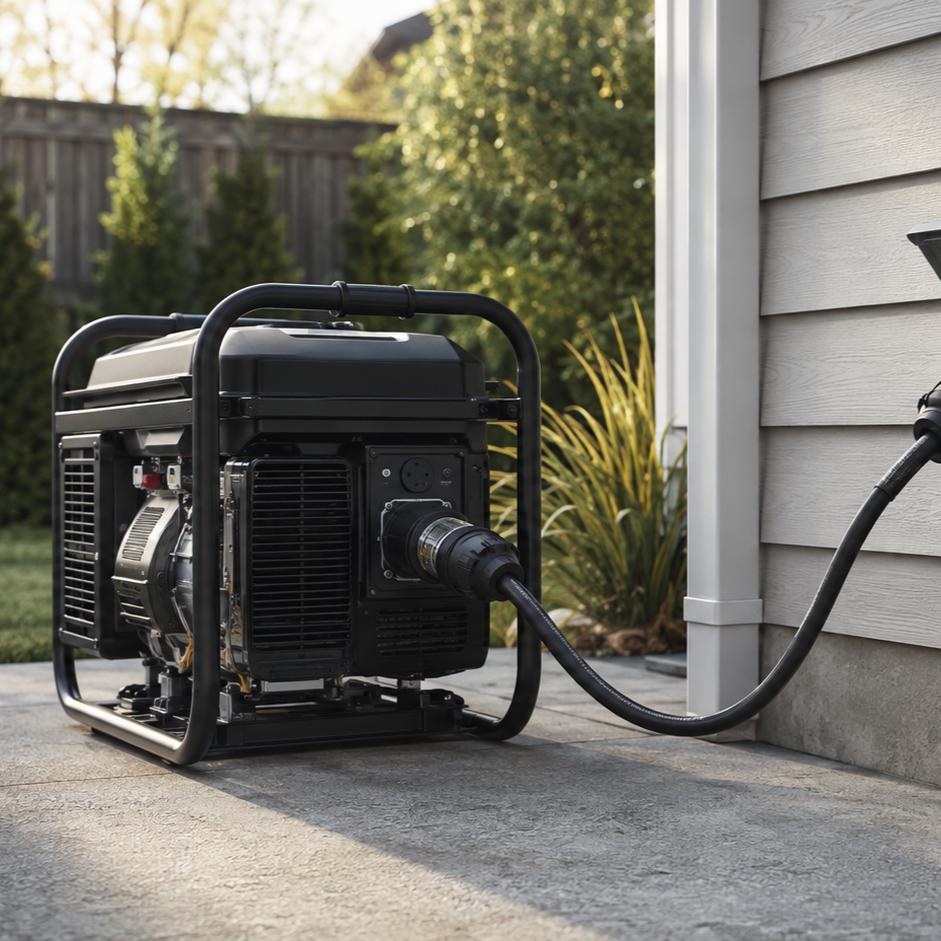
The power has been out for a couple of hours, the food in the freezer is starting to worry you, and the portable generator in the garage runs fine out on the patio. Then someone offers a shortcut they swear they have used for years: a length of cord with a regular plug molded onto both ends, run from the generator's outlet straight into the dryer receptacle or a wall socket. Flip the main breaker off, they say, plug it in, and the whole house comes back to life. It sounds clever. It is one of the most dangerous things you can do with a generator, and electricians and utility crews have a grim nickname for that double-ended cord: a suicide cord.
The reason has nothing to do with whether the generator is big enough or the cord is thick enough. It is about where the power goes once it enters your wiring, and who can be standing in its path.
The Power Does Not Stay in Your House
Plug a generator into an outlet, and you have not fed one appliance. You have fed the whole circuit, and through it, the panel. Every outlet, light, and breaker in the house connects back to the two busbars inside your electrical panel. Push power in at any outlet, and it travels backward up that branch circuit to the bus, then out along every other circuit at once. That is backfeeding: energy flowing the wrong direction through wiring built to carry it the other way.
If the main breaker is still on, that energy does not stop at your walls. It runs out through the main, through your meter, and onto the utility service line feeding your home, the same line a lineworker may be repairing a few streets away, believing it is dead.
WARNING: A generator backfeeding through your panel can push lethal voltage onto the utility lines outside. A lineworker restoring power, or a neighbor on the same transformer, can be electrocuted by a line they have every reason to think is de-energized. This is the single most serious risk of backfeeding, and it is why the practice is never acceptable.
The Transformer Turns Your Generator Into a High-Voltage Source
Here is the part that surprises people. The transformer on the pole or pad outside your home steps the utility's distribution voltage, often several thousand volts, down to the 240 volts that enters your panel. A transformer does not care which way current flows through it. Feed 240 volts backward into it from your generator, and it runs in reverse, stepping that 240 volts up to the thousands of volts it normally sends down.
So a modest generator, harmless-looking on the patio, becomes the source of high-voltage power on the neighborhood lines. The voltage that reaches a lineworker's gloves is not your generator's 240; it is what the transformer multiplies it into. That is why "it's only a small generator" offers no safety at all.
The Cord Itself Is a Hazard
Set the grid aside for a moment, because the cord alone can hurt someone in the room. A suicide cord has a male plug on both ends. The moment one end is energized, either by the running generator or by power backfeeding from the panel, the prongs on the other end are live and exposed. Those bare metal prongs sit at full voltage with nothing covering them, waiting for a hand, a curious child, or a pet to make contact.
There is a second problem hiding inside the wall. When you feed the panel through a single 15- or 20-amp outlet, all the current the house draws now funnels through that one branch circuit and the thin wire behind it. That wire was sized for one room's worth of load, not the whole house, and the breaker meant to protect it has been bypassed entirely. Overcurrent protection only works when power flows the direction the breaker expects. Backfed from the load side, the breaker cannot trip on that overload, so the wire can quietly overheat inside the wall with nothing to stop it. That is a fire that starts where you cannot see it.
When the Utility Power Returns
The last danger arrives at the moment you are relieved the outage is over. If the generator is still connected and the main breaker was left on, utility power snaps back onto lines that your generator is also energizing. Two out-of-sync power sources collide. The generator, never built to synchronize with the grid, can be destroyed instantly, and the surge can damage the appliances you were trying to protect. Even where a main breaker was switched off to isolate the house, resting your safety on one manually thrown breaker is exactly the failure point every proper method is designed to remove.
The Safe Ways to Connect a Generator
Safely powering a home from a generator is well-established work, and every proper method shares one principle: the house is never connected to the generator and the utility at the same time. An electrician installs one of three setups.
A transfer switch: This is the cleanest solution. A transfer switch mounts beside your panel and routes selected circuits to either the utility or the generator, never both. A manual model uses a switch you throw by hand; an automatic one senses the outage and changes over on its own, common with standby generators. Because the switch cannot connect both sources at once, backfeed onto the utility line is impossible by design.
A breaker interlock kit: A simpler retrofit for many homes, an interlock is a sliding metal plate fitted to your existing panel. It lets you install a dedicated generator breaker but mechanically blocks the main breaker and the generator breaker from ever being on together. To turn the generator breaker on, you first have to turn the main off, which severs the tie to the grid. It has to be the interlock engineered for your specific panel brand and model, which is why it is an electrician's install and not a universal part.
A dedicated inlet box and generator cord: Mounted on an outside wall, a power inlet box gives you a proper, weatherproof receptacle to plug the generator into using a heavy, twist-lock generator cord (a locking connector such as an L14-30, not a household plug). The inlet feeds the transfer switch or interlocked breaker inside. Both ends of a real generator cord are shrouded and locking, so there are no exposed live prongs at any point.
Whichever setup fits your home, the work involves opening the panel and tying into the service, so it is installed by a licensed electrician who also sizes it to the circuits you actually need to run during an outage.
What It Comes Down To
Backfeeding through an outlet skips every protection the electrical system is built around: the barrier between your home and the grid, the breaker that guards the wire, and the shrouding that keeps live metal out of reach. It puts a lineworker, your neighbors, your household, and your own equipment at risk rather than using a proper connection. A transfer switch, an interlock kit, or an inlet box does the same job the cord promises without any of the danger, and a generator wired in through one of them is ready to use safely the next time the lights go out.
Frequently Asked Questions
Turning off the main removes one path to the grid, but it makes the whole setup depend on human memory and a single mechanical switch. Forget it once, or have a family member flip it back thinking it restores normal power, and the generator is feeding the utility line. A breaker interlock exists precisely because a manually thrown main is not a reliable safeguard; the interlock makes it physically impossible to have both breakers on at once. The exposed prongs on the cord and the bypassed branch-circuit protection are also still hazards even with the main off.
Yes, and it usually happens when utility power returns while the generator is still connected. The grid and your generator are not synchronized, so when they meet, the generator's rotor is forced against the far larger grid, which can wreck its windings or engine in an instant. A backfed generator can also be overloaded by the whole house trying to draw through it. This is separate from the shock and fire risks, and it is one more reason the connection needs a switch that keeps the two sources apart.
Both prevent the grid and generator from connecting at once, but they do it differently. A transfer switch is a separate enclosure that manages a chosen set of circuits, and an automatic version can switch over by itself. An interlock kit is a metal plate added to your existing panel that lets the whole panel be generator-fed while blocking the main and generator breakers from being on together. An interlock uses the panel you already have and can feed more of the home's circuits, while a transfer switch offers automatic operation and a tidy dedicated enclosure. An electrician can advise which suits your panel and generator.
Because a household receptacle and its 15- or 20-amp wiring are sized for a single circuit, not for carrying an entire home's load. People often reach for a 30-amp dryer outlet (a NEMA 14-30) thinking it is heavy enough, but even that is rated for one appliance on its own circuit, not the whole panel, and plugging into it still backfeeds the bus the same way a wall socket does. A dedicated inlet box uses a properly rated circuit and a locking connector matched to the generator's output, so the wire, the connection, and the overcurrent protection all line up the way they should.
No, and that is the point of how they are installed. A permanently mounted standby generator is wired through an automatic transfer switch as part of the installation, so it can never backfeed the utility. The backfeed hazard is specific to portable generators improperly connected with a double-ended cord. If you own a portable unit, adding an inlet box with a transfer switch or interlock gives it the same protection a standby system has built in.
Running a properly rated extension cord from the generator directly to individual appliances is the one safe way to use a portable unit with no panel work, and it avoids backfeeding entirely because nothing touches your home wiring. The trade-offs are that you can only power what a cord reaches, and you cannot run hardwired equipment like a furnace, well pump, or built-in range. Keep the generator well outside and away from windows for exhaust reasons, and use outdoor-rated cords sized for the load. For anything hardwired, an inlet box with a transfer switch or interlock is the route.
Ask a licensed electrician to install a transfer switch, interlock kit, or generator inlet box—get your generator wired to power the house safely before the next outage. Efficient Electric serves Phoenix, Peoria, and the surrounding West Valley. Call (623) 810-9905.